Back to Blog Page
From Prompt Engineering to Context Engineering: The Next...
September 14, 2026


In February 2024, a breach at a mid-sized lending platform exposed the personal and financial records of over 1.5 million users. The company had passed its last external audit. It had a dedicated security team. It had a compliance certificate on its website. What it didn’t have was a development partner who treated security as architecture – not an afterthought.
That distinction is everything.
Enterprise-level FinTech clients – whether they’re running payment infrastructure, lending products, or wealth management platforms – aren’t asking whether you follow best practices. They’re asking whether you can prove it, document it, and maintain it through every sprint, every integration, and every update. If the answer is even slightly uncertain, they move on.
This is what ‘bank-grade’ actually means – not a marketing phrase, but a measurable engineering standard that determines whether your platform survives contact with regulators, security auditors, and the inevitable attempt to break in.

When a FinTech company comes to a development partner, the conversation usually starts in the right place: compliance. GDPR, PCI-DSS, SOC 2 – these are the acronyms that make it into the brief. But compliance is a floor, not a ceiling. And most security incidents don’t happen because a company skipped compliance. They happen because of the gaps between the requirements.
Here are the vulnerabilities that actually keep enterprise security teams awake:
None of these are exotic. Every one of them is preventable. The difference between a platform that enterprise clients trust and one they quietly walk away from is whether your development team treats these as engineering problems – not compliance checkboxes.
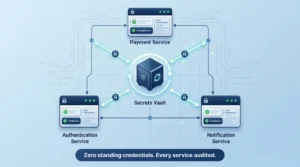
Consider how a modern payment gateway built for institutional clients approaches its token management layer. Rather than storing API credentials in environment variables (which is common and inadequate), the engineering team implements a secrets manager – AWS Secrets Manager or HashiCorp Vault – with automated rotation policies and strict IAM role boundaries. Every service has access only to the secrets it needs, for as long as it needs them.
This single architectural decision eliminates an entire category of breach. It adds roughly three days to a build. And it’s the kind of thing that enterprise security reviewers notice immediately – which is why platforms built this way close their deals faster.
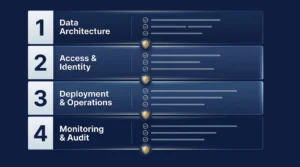
Before any serious financial institution signs off on a vendor’s platform, an internal team runs through a review that covers far more than a standard compliance checklist. Here’s the framework that experienced FinTech development teams build against from the first day of architecture:
A financial services firm in the US engaged a development agency to build a payment orchestration layer for their enterprise clients. The agency delivered on time, at a competitive price. Eighteen months later, a routine security review found that session tokens were being logged in plaintext in the application’s debug output – which had been left enabled in production.
The cost of remediation was not a patch and a redeployment. It was a full audit of every log file produced since launch, a 72-hour mandatory notification window with enterprise clients, and an internal review that delayed their next product release by four months.
Security vulnerabilities in financial applications are not bugs. They are liabilities. And unlike a UI bug or a slow query, they don’t announce themselves until someone else has already exploited them.
The development partners who win enterprise FinTech clients in 2026 are the ones who can walk into a security review and say: here is our threat model, here is our control matrix, here is how we’ve tested it. Not ‘we follow OWASP.’ Not ‘our code is reviewed.’ A documented, tested, ownership-assigned security architecture.
If you’re evaluating a development firm for a financial application – whether it’s a payment platform, a lending product, or an investment management tool – here’s what the answers to your questions should look like:
Enterprise clients don’t expect perfection. They expect accountability, documentation, and a partner who treats security the same way they do – as an ongoing engineering discipline, not a one-time project deliverable.
The economics of financial software security are simple and brutal. Building a secure architecture from day one adds time and cost to a project. Retrofitting security into an existing financial platform costs, on average, several times more than building it correctly initially. And recovering from a breach – in legal costs, client remediation, regulatory fines, and reputation – dwarfs both.
The conversation with enterprise clients is not ‘can you afford security-first development?’ It’s ‘can you afford anything else?’
For companies building payment infrastructure, lending platforms, or financial data products, bank-grade security is not a premium option. It is the baseline. The development partners who understand this – and can prove it through architecture, documentation, and testing — are the ones who are closing enterprise deals in 2026.