Back to Blog Page
You Don’t Have an AI Problem. You Have...
October 27, 2026

An AI project can move from an idea to a working model surprisingly quickly.
The data is prepared. The model is trained. The proof of concept works. The accuracy looks promising. The business stakeholders are impressed.
Then someone asks:
“When can we put this into production?”
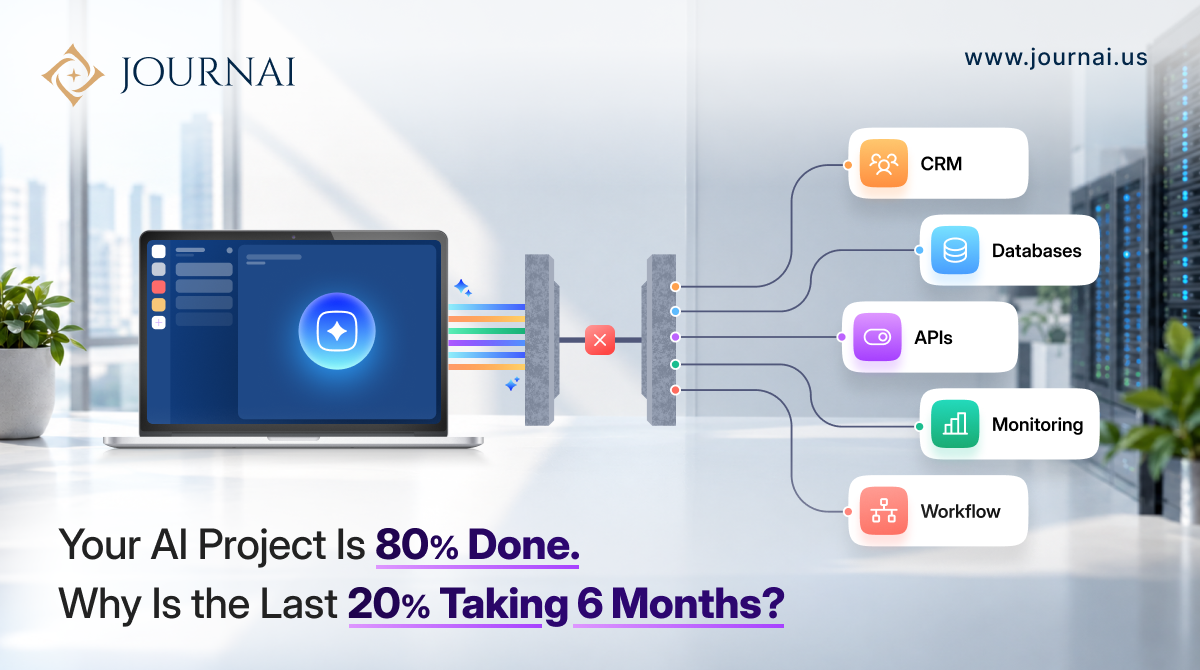
Suddenly, the project that looked 80% complete still has months of work ahead.
The model needs to connect with existing systems. Production data needs to flow reliably. Security requirements need to be addressed. Monitoring needs to be implemented. Edge cases need to be tested. Business workflows need to be defined. Employees need to know how to use the output.
This is one of the most common realities of production AI.
The difficult part is often not building the model. It is making the entire AI capability production-ready.
An AI model can be technically successful while the overall project is still far from ready for real users.
Consider an AI system designed to classify incoming customer requests.
The development team may have already:
From a development perspective, the project may feel almost complete.
Production introduces a completely different set of questions.
Where does new data come from?
How does the application send data to the model?
Where is the prediction stored?
What happens when the model is unavailable?
How is incorrect output handled?
Who can access the system?
How is model performance monitored?
What happens when the data changes?
How does the prediction affect the customer’s workflow?
These questions may not matter much during a controlled proof of concept.
They become critical when the system is expected to operate every day.
The first part of an AI project is usually about proving that something can work.
The final stage is about proving that it can keep working.
A development environment can tolerate manual processes. Production cannot.
A developer might manually upload a dataset during experimentation. A production system may need to process thousands of records automatically.
A developer can manually inspect model results. Production requires monitoring, alerts, logging, and defined responses to failures.
A prototype may work for a handful of users. Production needs to handle real traffic, unexpected inputs, system failures, and changing requirements.
The model may be ready.
The system around the model is not.

One of the biggest reasons AI projects slow down near production is integration.
Most businesses already depend on multiple systems:
AI needs to work with these systems rather than operate in isolation.
Imagine an AI model that predicts which customers are most likely to purchase a product.
The model generates a prediction, but that prediction has limited value if it remains inside the machine learning environment.
It needs to reach the CRM.
The sales team needs to see it.
The right customer needs to be identified.
The recommendation may need to trigger a task.
The sales activity needs to be recorded.
And the organization needs to measure whether the recommendation actually improves conversion.
The model may take days to build.
Making all these systems work together can take months.
This is why AI integration can become a larger engineering challenge than model development.
During a proof of concept, teams often work with a prepared dataset.
Production data is different.
It arrives continuously. It may be incomplete, inconsistent, delayed, or structured differently from the original training data.
A production AI system therefore needs reliable data pipelines that can collect, validate, transform, and deliver information to the model.
Those pipelines also need mechanisms to detect when something goes wrong.
A model cannot consistently produce reliable results from unreliable inputs.
Production AI therefore depends on several important data capabilities:
Production AI is only as reliable as the data pipeline supporting it.
Security is another reason the final stage can take longer than expected.
A prototype might use sample data.
A production AI system could process customer information, financial information, internal business data, or other sensitive information.
That changes the requirements.
Organizations may need:
The question is no longer simply:
“Can the model process this data?”
It becomes:
“Can the organization safely allow this system to process this data?”
That is a much larger production requirement.
Deploying an AI system is not the end of the project.
AI systems can change in performance even when the underlying model has not been modified.
Customer behavior changes. Markets change. Products change. Business processes change. Input data changes.
A model can therefore remain online while becoming less useful.
Production monitoring needs to answer two questions:
Is the system running?
and
Is the AI still performing as expected?
Teams may need to monitor:
Without this visibility, organizations may discover problems only after business performance has already been affected.
AI systems also require a broader approach to testing.
Traditional software often follows predictable rules. AI systems can be probabilistic and may behave differently across different inputs.
A production AI system may need to be evaluated for:
The goal is not simply to prove that the model works.
It is to understand how the entire AI system behaves when things do not go according to plan.
Even after the technical infrastructure is ready, one major question remains:
What should people actually do with the AI output?
Suppose an AI system identifies a customer as high risk for churn.
The prediction is generated successfully.
Now what?
Should the customer success manager receive an alert?
Should the CRM automatically create a task?
Should a human review the prediction?
Should different risk levels trigger different actions?
These are business decisions.
Technology alone cannot answer them.
An AI system creates value when its output leads to a meaningful action.
Without that connection, the organization may simply have another dashboard displaying another prediction.

Not every AI system needs to operate completely autonomously.
In many business environments, a better approach is to combine AI with human judgment.
AI can:
Analyze → Predict → Recommend
while the employee:
Reviews → Decides → Acts
This approach allows organizations to benefit from AI while maintaining human accountability, particularly when incorrect decisions can have significant consequences.
The goal is not always to remove people from the process.
It can be to help people make better decisions faster.
The biggest mistake is waiting until the model is finished before thinking about production.
Teams should consider production requirements during the initial AI design.
Important questions include:
These questions reduce the gap between experimentation and production.
Instead of treating production readiness as a final checklist, organizations can make it part of the AI architecture from the beginning.
The AI journey should not look like:
Build Model → Finish Model → Think About Production
A stronger approach is:
Business Problem → Data → AI Experiment → Production Architecture → Integration → Security → Testing → Monitoring → Workflow → Adoption → Measurement
Each stage prepares the next.
The model remains important, but it becomes one component of a larger business capability.
That is why project progress should not be measured only by how much of the model has been completed.
The more important question is:
“How close are we to a production-ready AI capability?”
The frustrating part about the final 20% is that it often contains the work that determines whether the entire project succeeds.
Building the model proves technical feasibility.
Production readiness proves operational feasibility.
Integration connects intelligence with business systems.
Workflow design connects predictions with actions.
Monitoring keeps the system useful.
Human oversight keeps decisions accountable.
Measurement proves whether the investment is creating value.
That is why the final 20% can take six months.
It is not simply the remaining development work.
It is the work of turning an AI experiment into something the business can actually depend on.
The first 80% may prove that the idea is possible.
The last 20% proves that the idea is useful.
And in production AI, that final distinction is everything.