 Back to Blog Page
A machine learning model can be accurate, impressive, and technically successful—and still fail to create business value.
The model works.
The demo works.
The proof of concept gets approved.
And then production begins.
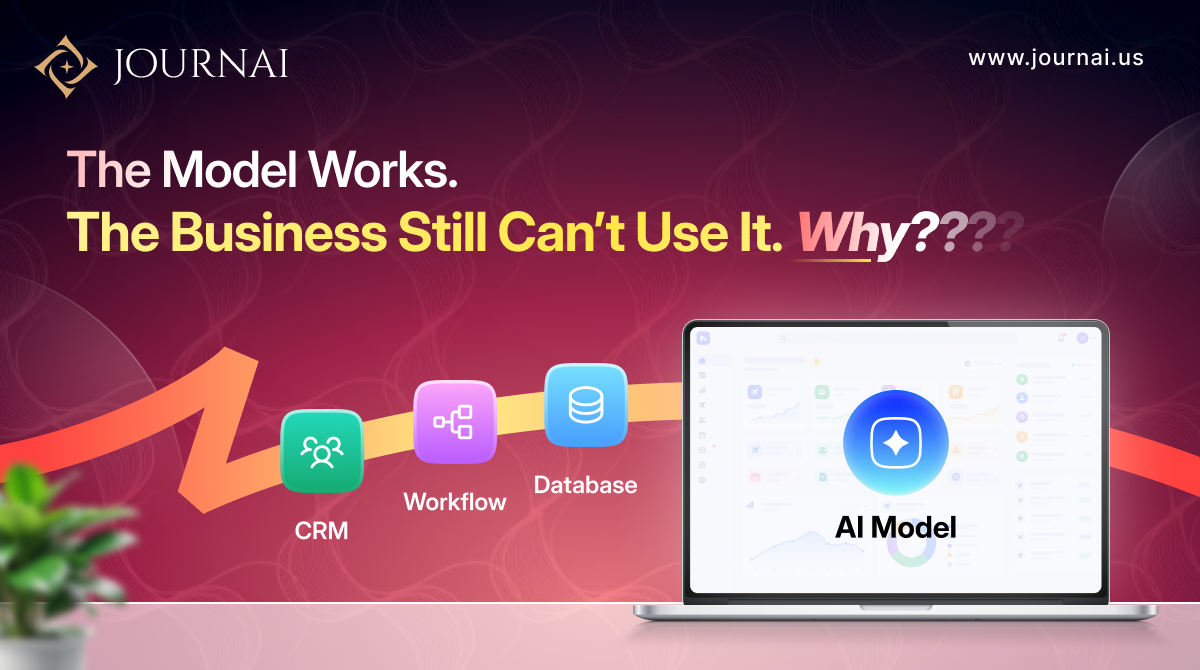
Suddenly, the organization discovers that the model needs to connect with existing systems, process real-world data, respond quickly enough for users, follow security requirements, handle changing conditions, and fit into workflows that were never designed around AI.
This is one of the most important realities of business AI:
Building a model is not the same as building an AI capability.
The model answers whether a technical idea can work.
The business needs to know whether that idea can operate reliably in the real world.
A Successful PoC Can Still Be a Production Failure
Consider a company developing an AI system to predict customer churn.
The data science team trains a model using historical customer data. The results are promising. The model correctly identifies a large percentage of customers who are likely to leave.
The proof of concept succeeds.
But what happens next?
The prediction needs to reach the CRM.
The sales or customer success team needs to see it.
Someone needs to determine what action should follow the prediction.
The system needs to process new customer data continuously.
The model needs to be monitored as customer behavior changes.
And the organization needs to know whether acting on those predictions actually reduces churn.
Without these pieces, the model may remain a successful experiment sitting inside a notebook or isolated application.
Technically successful.
Operationally useless.

Production Changes the Problem
During experimentation, AI systems operate under controlled conditions.
The data is usually known. The infrastructure is limited. The number of users is small. Developers can manually inspect results.
Production removes those assumptions.
Data arrives continuously.
Users expect fast responses.
Systems need to remain available.
Business rules change.
Input quality varies.
Infrastructure costs become important.
Security becomes critical.
And the consequences of incorrect predictions become much more significant.
A model that performs well on yesterday’s dataset may behave differently when exposed to today’s customers.
This is why production AI requires thinking beyond accuracy.
Accuracy is a model metric. Reliability is a business requirement.
The Model Is Only One Component
A production AI capability is made up of much more than the model itself.
It may involve:
- Data pipelines
- APIs
- Databases
- Application logic
- Cloud infrastructure
- Authentication
- Monitoring
- Logging
- Model versioning
- Security controls
- Human review
- Business rules
- Feedback mechanisms
The model sits inside this larger system.
If any important connection fails, the AI capability can fail with it.
For example, an AI model might correctly identify a high-value sales opportunity. But if that prediction never reaches the CRM, the salesperson cannot act on it.
The problem is not model performance.
The problem is integration.
AI Creates Value When It Changes a Workflow
This is where businesses need to think differently about AI.
Instead of asking:
“Where can we use AI?”
A better question is:
“Which business process could become significantly better if AI were integrated into it?”
Consider customer support.
A basic AI implementation might generate answers to customer questions.
A more integrated approach could analyze the incoming request, identify its intent, retrieve relevant customer information, suggest a response, determine whether escalation is necessary, update the support system, and provide the employee with the next recommended action.
The difference is significant.
The first approach adds an AI feature.
The second approach changes how the business process operates.
That is where AI starts becoming an operational capability.
The Integration Layer Is Where Business Value Lives
Most organizations already have systems that run their businesses.
CRMs manage customers.
ERP systems manage operations.
Payment systems manage transactions.
Ticketing platforms manage support.
Analytics platforms provide reporting.
Internal applications manage specialized workflows.
AI does not replace all of these systems.
In many cases, its value comes from working with them.
An AI model might analyze information from a CRM, make a prediction, send that prediction back to the CRM, trigger an internal workflow, and provide employees with a recommendation.
The intelligence comes from the model.
The business value comes from what happens around it.
This is why AI integration has become such an important part of enterprise AI.
What Happens When Data Changes?
One of the most overlooked problems in production AI is that the world does not remain static.
Customer behavior changes.
Markets change.
Products change.
Regulations change.
Business processes change.
Even the way users interact with an application can change.
A model trained on historical patterns may gradually encounter situations that were not represented in its original training data.
Its performance can decline without the model itself changing.
This creates another important requirement for production AI:
AI systems need to be observed, evaluated, and improved continuously.
Building the model is a milestone.
Maintaining its usefulness is an ongoing process.
Human Decisions Still Matter
Another common mistake is assuming that AI must completely automate a process to create value.
It does not.
In many business environments, the strongest implementation is a combination of AI and human judgment.
AI can identify patterns, summarize information, rank options, detect anomalies, or recommend actions.
A person can then review the recommendation and make the final decision.
For example, an AI system may identify a transaction as potentially fraudulent.
The objective does not necessarily have to be:
AI detects fraud → transaction automatically blocked.
A more appropriate workflow might be:
AI detects unusual behavior → risk score is generated → relevant information is presented → specialist reviews → decision is recorded.
The AI improves the decision-making process without removing human accountability.
The right balance depends on the business process, risk level, and consequences of an incorrect decision.
AI Adoption Is Also an Organizational Challenge
Even a technically excellent AI system can fail if employees do not know how to use it.
Imagine introducing an AI recommendation system to a sales team.
If the recommendation appears in a separate dashboard that salespeople rarely open, adoption will be low.
If the recommendation appears directly inside the workflow where salespeople already work, adoption can be much higher.
This illustrates an important principle:
AI adoption is not only about technology. It is about where and how the technology enters people’s work.
The best AI systems often become almost invisible.
They appear inside existing workflows.
They reduce repetitive work.
They provide information at the right moment.
They help employees make better decisions without forcing them to learn an entirely new system.

Measuring AI by Business Outcomes
Another shift businesses need to make is how they measure AI success.
A model can have excellent technical performance and still have little business impact.
Instead of measuring only:
- Accuracy
- Precision
- Recall
- Latency
- Model performance
Businesses should also consider:
- Time saved
- Revenue generated
- Costs reduced
- Errors prevented
- Customer satisfaction
- Employee productivity
- Conversion rates
- Decision-making speed
- Process efficiency
The right metric depends on the use case.
For example, an AI system designed to automate document processing may be valuable because it reduces processing time by several hours per day.
An AI recommendation engine may be valuable because it increases conversion.
An AI support assistant may be valuable because it reduces response times.
The model is not the final product.
The business outcome is.
From Proof of Concept to Production Capability
The transition from PoC to production should therefore be treated as a transformation of the entire workflow.
A useful way to think about the journey is:
Business Problem → AI Experiment → Production System → Workflow Integration → User Adoption → Measurement → Continuous Improvement
Each stage answers a different question.
AI Experiment: Can this work?
Production System: Can this operate reliably?
Workflow Integration: Can the business use it?
User Adoption: Will people actually use it?
Measurement: Is it creating value?
Continuous Improvement: Can that value be sustained?
Skipping any of these stages can create an AI system that technically works but operationally fails.
The Future Is Not About More AI Models
Businesses do not necessarily need more models.
They need better ways to turn AI capabilities into business outcomes.
The competitive advantage will increasingly come from knowing where AI belongs, how it should interact with existing systems, what decisions it should support, what work it should automate, and where humans should remain involved.
The organizations that succeed with AI will not simply be the ones that experiment with the newest models.
They will be the ones that can consistently move from AI capability to operational impact.
The Model Working Is Only the Beginning
A successful proof of concept is worth celebrating.
But it should not be confused with the finish line.
The real test begins when the model meets real data, real users, real systems, and real business expectations.
That is when organizations discover whether they have built an AI experiment—or an AI capability.
The difference is not necessarily the sophistication of the model.
It is how well AI is integrated into the way the business actually operates.
Because the ultimate question is not, “Does the model work?”
It is, “What happens when the business depends on it?”