Back to Blog Page
Managing Technical Debt: How JournAI Builds “Clean” Code...
September 21, 2026

It started with a familiar expense.
A growing company was paying for another software subscription. It wasn’t particularly expensive. The tool handled a repetitive internal process, the team knew how to use it, and nobody was complaining about the monthly bill.
At first, the subscription looked like the obvious choice.
Why spend weeks building something when a ready-made product costs less than a hundred dollars a month?
Then the business grew.
The team needed a workflow the product didn’t support. They found a workaround. A few months later, another requirement appeared. Another workaround was added.
Eventually, the company was paying for the software and spending internal time trying to make the software fit the way the business actually worked.
That led to a different question:
Was the monthly subscription really cheaper, or was the company simply paying the cost in a different way?
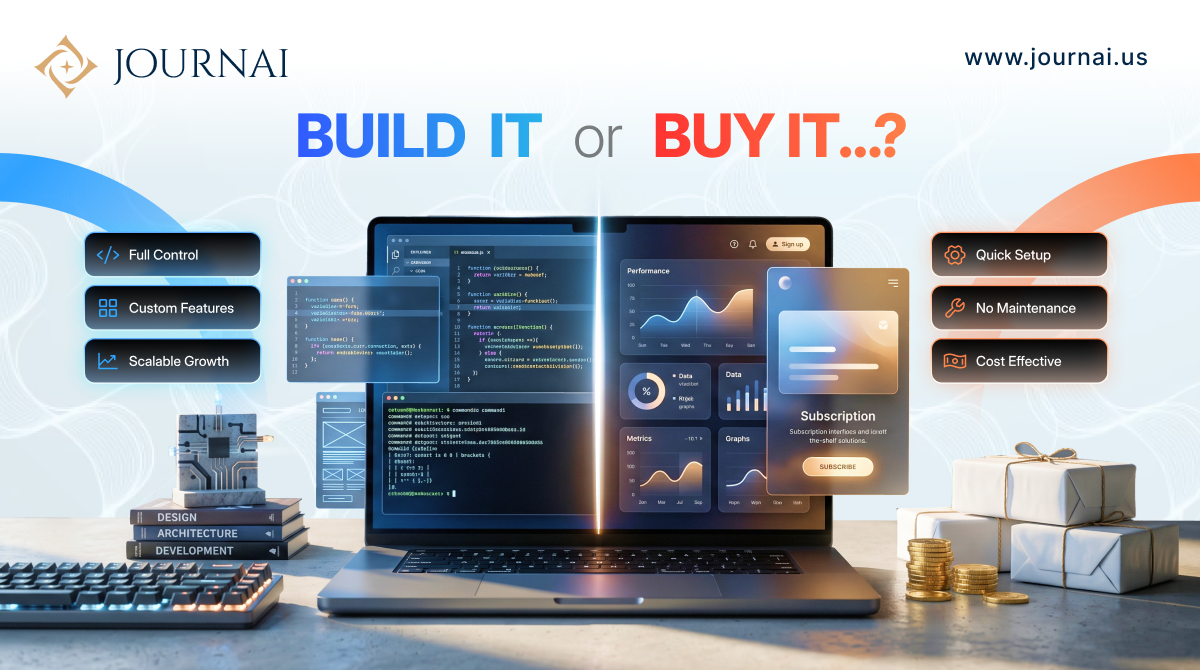
This is where the build-vs-buy discussion becomes interesting.
The decision isn’t simply about comparing a developer’s salary with a monthly subscription.
It is about understanding total cost, opportunity cost, flexibility, risk, and business value.
When a company evaluates a SaaS product, the first number it usually sees is the subscription price.
Perhaps it is $50 per user each month.
Perhaps it is $500.
Perhaps it is several thousand dollars for an enterprise plan.
That number is useful, but it isn’t the complete cost.
A proper comparison should consider what happens around the subscription as well.
For example:
AWS’s guidance on build-vs-buy decisions makes a similar point: organizations need to consider opportunity cost, maintenance, control, cost, and time to value, rather than looking at the purchase price alone.
A $100 monthly tool may be an excellent decision.
But it should be evaluated against the real business cost, not just the invoice.
AWS recommends evaluating the total cost of ownership by considering not only the service cost, but also the operational and management costs associated with using it.
There are many situations where building software internally would simply be unnecessary.
Imagine a company needs an accounting platform.
Building an accounting system from scratch would require development, security, testing, compliance work, maintenance, updates, and ongoing support.
If established products already solve the problem reliably, building another one may not create meaningful business value.
The same thinking can apply to many everyday requirements:
If the requirement is common across thousands of businesses, there is often little reason to recreate the entire system internally.
The company can spend its engineering resources somewhere more valuable.
The question isn’t “Can we build it?”
A capable development team can build many things.
The better question is:
“Should we spend our limited engineering time building this?”
AWS notes that build-vs-buy decisions should also consider opportunity cost, including the value engineering teams could create if they worked on other business priorities instead of building the software internally
The situation changes when the software directly affects how the business competes.
Consider a company with a unique booking workflow.
Its competitors don’t operate in exactly the same way. Customers expect a particular experience, and the internal team needs a workflow that doesn’t exist in standard SaaS products.
The company could force its process into an existing platform.
Or it could build software around the process.
This is where custom development can make sense.
A custom system can provide control over:
AWS has described this distinction through the idea that businesses should consider building software where technology creates differentiation while buying capabilities that don’t provide meaningful competitive advantage.
That doesn’t mean every unique requirement deserves a custom application.
It means uniqueness should be part of the economic conversation.

Building software has an obvious cost: developers need time to create it.
But development is only the beginning.
A custom application may also require:
This is why comparing “$500 monthly subscription” with “developer builds it for $20,000” can be misleading.
The custom solution may eventually require additional investment.
At the same time, the SaaS product isn’t free after purchase. Subscription costs can continue for years, potentially increase with usage, and may require additional integration or customization work.
AWS’s Well-Architected guidance recommends calculating the total cost of ownership by including operational and management costs rather than looking at the cost of an individual component alone.
The important number isn’t the first payment.
It’s the cost of owning or using the solution over the period that matters to the business.
The build-vs-buy decision is often presented as two choices.
Build everything.
Or buy everything.
Modern software development makes a third option increasingly practical.
AWS describes this approach as “tailoring,” where organizations combine existing technology building blocks with custom development for the parts that require their own business-specific capabilities.
Use existing building blocks and build only what is unique.
A business might use Stripe for payments, Twilio for messaging, AWS for infrastructure, and an existing analytics platform while developing its own customer-facing application and business logic.
This approach avoids rebuilding mature infrastructure while still allowing the company to create experiences that are specific to its customers.
AWS has described this approach as “tailoring”—using existing technology components as a foundation while building the parts that require customization.
This can be especially useful for growing businesses.
Instead of spending engineering resources recreating commodity functionality, developers can focus on the part of the product that actually creates value.
Buying software also introduces another consideration: dependency.
If a business builds its entire workflow around one vendor, moving away later may become difficult.
Data may need to be migrated. Integrations may need to be rebuilt. Employees may need to learn another platform. Historical information may need to be transformed.
AWS specifically identifies vendor lock-in and switching costs as important considerations in build-vs-buy decisions.
That doesn’t mean vendor lock-in automatically makes SaaS a bad choice.
Sometimes the productivity gained from using a mature product is worth the dependency.
The important thing is to understand the dependency before making the decision.
Before signing a long-term agreement, businesses can ask:
These questions don’t prevent vendor relationships.
They make those relationships more intentional.
The original company eventually realized that it didn’t need to choose between two extremes.
It didn’t need to rebuild every tool it used.
It also didn’t need to accept every limitation of its existing subscriptions.
Instead, it identified the workflows that genuinely differentiated the business and invested engineering resources there.
For everything else, existing products and services remained useful.
That is often the more practical approach to software strategy.
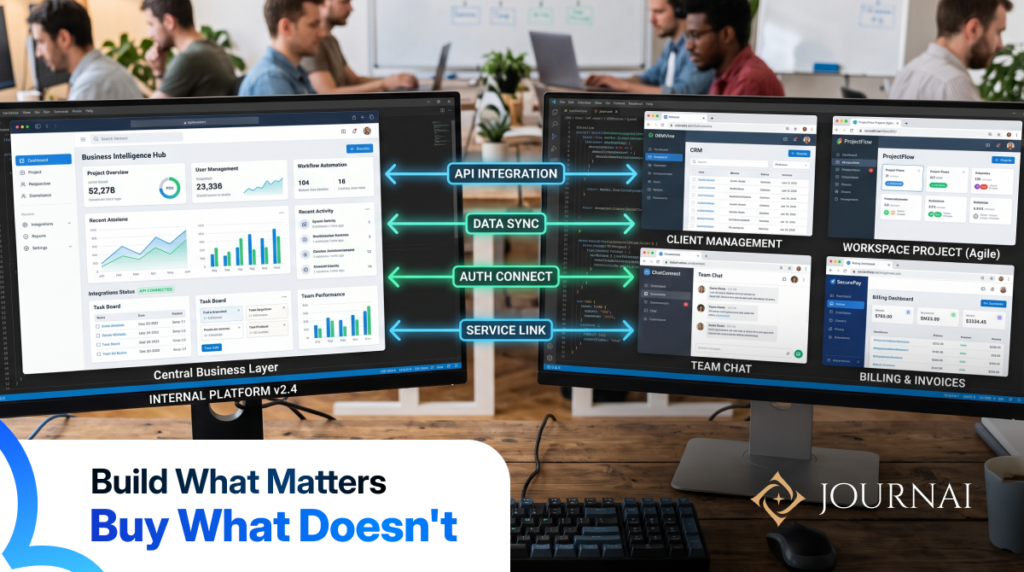
Buy the capabilities that are already solved well. Build the capabilities that make your business different. Connect the two intelligently.
A monthly subscription isn’t automatically expensive.
Custom software development isn’t automatically cost-effective.
The right choice depends on what the software needs to accomplish and what the business is willing to invest in over time.
The most useful questions are often:
What does the business need to control?
What already exists and works well?
Where can software create differentiation?
What will this decision cost over three to five years?
What will the team stop doing if it chooses to build this?
That final question is especially important.
Engineering capacity is limited.
Every hour spent rebuilding a common capability is an hour that isn’t being spent improving the core product.
Modern development makes the middle ground more attractive than ever. Teams can combine custom applications with APIs, cloud services, SaaS platforms, open-source frameworks, and managed infrastructure instead of rebuilding the entire technology stack from scratch.
At JournAI, software development can be approached with the same principle: build where technology creates meaningful value, and use proven solutions where reinventing the wheel doesn’t benefit the business.
Whether the requirement is a custom internal tool, customer-facing application, integration layer, or a larger digital product, the first step should not be choosing a technology.
It should be understanding the business problem.
Need help deciding what to build, what to buy, and where custom software can create real value?
Explore JournAI’s software development services and turn your technology investment into a strategy—not just another expense.