Back to Blog Page
From Prompt Engineering to Context Engineering: The Next...
September 14, 2026


It was supposed to be a normal Monday morning.
A customer opened an application, selected a service, entered their payment details, and clicked Pay. The payment was successful, but the order remained stuck in “Pending.” From the customer’s perspective, something had gone seriously wrong. They had been charged, but the application hadn’t confirmed what happened next.
The development team initially assumed it was a payment issue. After checking the payment provider, they discovered that the transaction had actually been processed successfully. The problem was somewhere between the payment response, the application’s database, and the business logic responsible for creating the order.
Then another customer reported something different. Their transaction had completed, but the confirmation message never arrived.
Two different symptoms were pointing toward the same underlying problem: the application wasn’t handling communication between its external services reliably enough.
This is a common challenge for modern software. Applications rarely work in isolation. They depend on payment platforms, communication providers, cloud storage, authentication services, CRMs, analytics tools, and many other systems.
The difficult part isn’t simply connecting these services.
The real challenge is making sure the entire conversation continues correctly when something goes wrong.
An API gives two systems a way to communicate. Your application can send a request, another platform can process it, and a response can come back.
That sounds straightforward during development.
For example, a Laravel application might use Stripe to process payments and Twilio to send customer notifications. A developer can make both integrations work in a testing environment within a relatively short time.
Production is different.
A request can time out even though the external service processed it. A webhook can arrive after the original request has already finished. The same event can be delivered more than once. An external service can temporarily become unavailable. A provider can also change its API over time.
Stripe specifically documents that webhook endpoints can receive duplicate events and recommends tracking processed event IDs so the same event isn’t handled twice. Stripe also recommends processing webhook events asynchronously when appropriate.
That means an integration cannot be designed around only the successful scenario.
A production-ready approach needs to think about what happens when the communication is delayed, duplicated, rejected, or interrupted.
During development, everything can look perfect.
A developer creates a test payment. The payment succeeds. The database updates. A confirmation message is sent. The team moves on to the next feature.
Once real customers start using the application, the environment becomes much less predictable. Multiple requests can arrive simultaneously, networks can become unreliable, external services can experience temporary issues, and users can click the same button more than once.
This is why third-party integration should be treated as part of the application’s architecture rather than as a small feature added at the end.
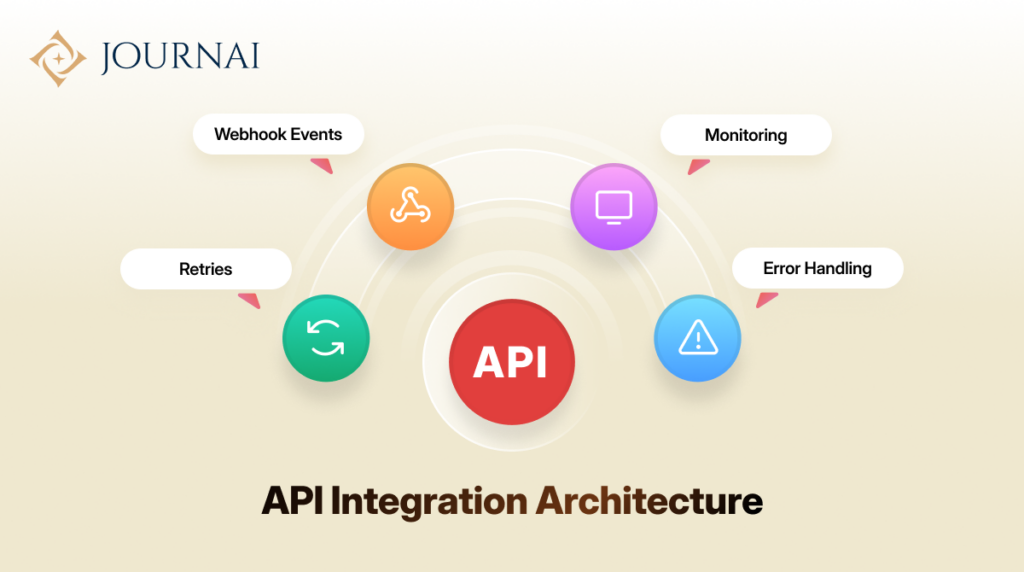
A reliable integration should account for areas such as:
Making an API call succeed is development. Designing what happens when it fails is engineering.

Another common mistake is treating every third-party service in exactly the same way.
A payment platform and a messaging provider may both use APIs, but the business consequences of failure are very different.
With Stripe, for example, confirming whether a payment actually succeeded is critical. Your application shouldn’t create uncertainty around whether a customer has been charged. Stripe’s webhook system is designed to notify applications about events that happen after the initial interaction, which is particularly useful for asynchronous payment flows.
Messaging has another set of concerns.
When an application sends a message through Twilio, the initial API response doesn’t necessarily mean the message has already reached the customer’s device. Twilio provides status callbacks that allow applications to track message states such as sent, delivered, failed, and undelivered.
That difference matters when designing the application.
For a payment integration, the dedicated development team may need to focus heavily on transaction consistency, webhook handling, duplicate prevention, refunds, and reconciliation.
For a messaging integration, delivery tracking, failed messages, status callbacks, templates, and provider limits may be more important.
The API may be different, but the bigger difference is what the business needs to happen after the request is sent.
Imagine a growing application where dozens of controllers directly communicate with Stripe, Twilio, a CRM, an email provider, and several other platforms.
It may work initially.
But over time, the application becomes difficult to maintain. A change in one provider’s API can require updates across multiple parts of the codebase. Developers also have to remember provider-specific rules every time they work on a business feature.
A cleaner architecture introduces a dedicated integration layer.
For example, the application can communicate with a Payment Service, while that service handles the details of communicating with Stripe.
Similarly, a Notification Service can manage communication with Twilio.
The business logic then focuses on what needs to happen, rather than how every external provider works.
This separation becomes especially valuable for businesses investing in Custom Web Application Development Services, because applications often grow from one integration into a much larger ecosystem of external platforms.
It also makes it easier to replace or add providers later without rewriting the application’s core business processes.
A good integration strategy begins by asking uncomfortable questions before production does.
Suppose a payment request times out.
Should the application immediately send the request again?
Not necessarily.
The first request might have reached the payment provider successfully even though your application never received the response. Sending another request without checking the transaction state could create a duplicate operation.
The same principle applies to other services.
Before adding automatic retries, developers should understand what the operation actually does and whether repeating it is safe.
A practical integration plan should define:
This is particularly important because external systems don’t always behave exactly as expected.
Twilio notes that status callback requests can arrive with changing network latency and that callback events are not guaranteed to arrive in the same order in which the status changes occurred.
So the application shouldn’t simply assume:
Event A arrives → then Event B arrives → then Event C arrives.
Production systems need to be designed around the possibility that reality will be less predictable.
There is another part of integration that is easy to overlook when everything is focused on functionality: security.
Third-party services often require API keys, authentication tokens, webhook endpoints, and access to business information. Those credentials need to be protected throughout the application lifecycle.
For example, a payment webhook should not simply be treated as a normal request because someone knows the endpoint URL. The application needs a way to verify that the event genuinely came from the expected provider.
Stripe provides webhook signature verification specifically for this purpose, helping applications verify incoming webhook requests.
The same mindset should apply to other external services.
Credentials should be stored securely, permissions should be limited to what the integration actually needs, and sensitive information shouldn’t accidentally appear in application logs.
Security isn’t a separate step after integration. It is part of building the integration correctly.
The first version of an API integration might be completed by one developer in a few days.
Six months later, another developer joins the team and asks a simple question:
“Why are we using this API version, and what happens if it goes down?”
If nobody knows the answer, the integration has become technical debt.
Good documentation doesn’t need to be complicated. It should make the important information easy to find:
This becomes increasingly important as an application grows.
One integration may become five. Five may become fifteen. Eventually, those connections become part of the product’s infrastructure.
Let’s go back to that Monday morning problem.
The payment provider hadn’t necessarily failed. The messaging provider hadn’t necessarily failed either.
The bigger issue was that the application hadn’t been designed to reliably manage the communication between multiple systems.
That is the difference between adding an API integration and developing an API strategy.
A thoughtful approach considers the complete journey:
Customer action → Application request → External service → Response or webhook → Business logic → Database → Customer experience
Every part has a responsibility.
Every important failure needs a response.
And every external dependency needs to be understood.
Modern applications will continue to depend on more third-party platforms. Payments, communications, authentication, analytics, cloud services, CRMs, and other tools can make products significantly more capable without requiring businesses to build everything themselves.
But every external dependency also introduces another conversation your software needs to handle.
The goal isn’t to prevent every failure.
The goal is to make sure one failed API interaction doesn’t become a failed customer experience.
Customers never see the API request happening behind the scenes.
They don’t see the webhook.
They don’t know whether a queue processed an event or whether a retry was triggered.
They simply expect the payment to complete, the order to appear, the notification to arrive, and the status to remain accurate.
That experience depends heavily on the architecture underneath the interface.
A well-planned API strategy gives your application a structured way to communicate with external platforms, handle unexpected behavior, protect sensitive information, and remain maintainable as the product grows.
For businesses building or scaling Laravel applications, this becomes even more important as integrations become part of everyday workflows.
As a custom web application development company, we include building custom applications and reliable integrations with payment gateways, communication platforms, CRMs, external APIs, and other business systems.
If your application is becoming dependent on multiple external services—or your existing integrations are becoming difficult to maintain—we can help you design a cleaner, more resilient architecture.
Don’t just connect your software to other platforms. Build it to communicate with them reliably.