Back to Blog Page
The Model Works. The Business Still Can’t Use...
October 13, 2026

The message came in on a Tuesday night: “Can we talk tomorrow? It’s urgent, but nothing’s broken.”
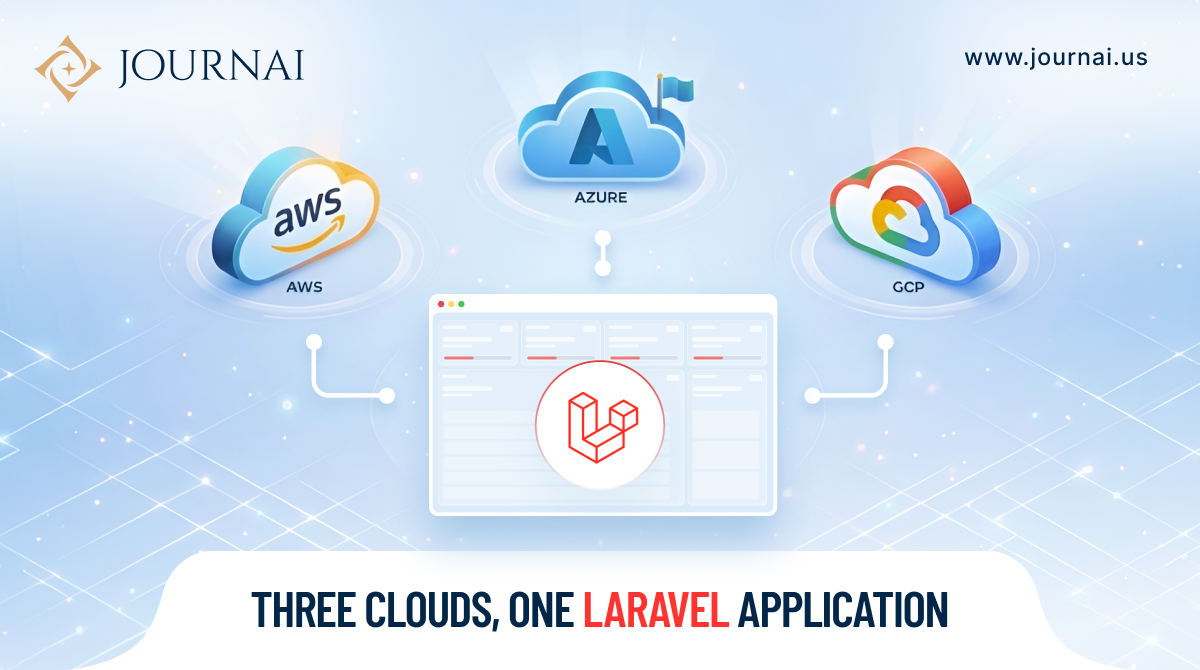
That second part turned out to be true, and also a little misleading. The founder on the other end ran a Laravel SaaS product we’d helped build over the past year — nothing fancy, just a solid multi-tenant app running comfortably on a single AWS setup. Revenue was climbing. The app hadn’t gone down in months. So the urgency wasn’t technical. It was his co-founder, fresh off a call with their first enterprise prospect, insisting they migrate everything to Azure “because that’s what the client runs on.”
He wasn’t asking us to move servers. He was asking a harder question: was AWS actually the wrong choice, or was this panic dressed up as strategy?
Here’s the part that doesn’t show up in most cloud comparison articles: the decision rarely gets made on technical merit. It gets made under pressure — a client’s procurement team asks a pointed question, a board member mentions a competitor’s stack, an engineer reads a blog post at 1 a.m. and panics. Laravel makes this worse in a subtle way, because Laravel itself doesn’t care which cloud it runs on. Forge, Envoyer, Vapor, a hand-rolled Docker pipeline — they all point comfortably at AWS, Azure, or GCP without complaint. So the framework never forces the conversation. The business does, usually at the worst possible moment.
That’s the hidden cost of not having a cloud strategy before you need one. It’s not downtime or bad performance. It’s a founder making a six-figure infrastructure decision reactively, based on someone else’s fear.
The instinct to chase whichever cloud a big client uses feels responsible. In practice, it just relocates the same unanswered questions to a new provider. Migrating to Azure wouldn’t have told us anything about whether the app needed enterprise-grade compliance tooling, a private VPC, or simply a signed questionnaire the sales team could hand over. Cloud migrations are expensive, slow, and — for a lean Laravel team — a significant distraction from shipping product. Doing one out of anxiety rather than necessity is how startups burn a quarter solving a problem they never actually had.

So we did what we always do before recommending anything: we looked past the client’s anxiety and at what’s actually happening across the industry.
AWS still leads by a wide margin, and not just in enterprise spending — the developer community backs it up too. The 2025 Stack Overflow Developer Survey found AWS remains the most-used cloud platform among developers, with 43% reporting they use it, comfortably ahead of Azure and Google Cloud. For a Laravel team, that translates into something very practical: more Forge-compatible tooling, more community answers when something breaks at 2 a.m., and an easier time hiring engineers who’ve already touched EC2 or RDS.
But popularity isn’t the whole story, and it wasn’t really the founder’s story either. Flexera’s 2026 State of the Cloud report found that hybrid cloud use has climbed to 73% of surveyed organizations — many of them landing on more than one provider without ever deciding to, usually because a client or acquisition pulled them there. That’s precisely the trap the founder was about to walk into: not a deliberate multi-cloud strategy, but an accidental one, dressed up as a client accommodation.
Meanwhile, the infrastructure underneath all three providers keeps converging. The CNCF Annual Cloud Native Survey found that 82% of container users now run Kubernetes in production, which means the tooling and hiring pool around containerized Laravel deployments — on EKS, AKS, or GKE — is deep no matter which provider you pick. And at the macro level, none of the three providers are going anywhere: Statista’s figures, based on Synergy Research Group estimates, put AWS at 28% of the worldwide cloud infrastructure market in early 2026, Azure at 21%, and Google Cloud at 14%, with the overall market growing 35% year over year. There’s no losing side in this race — just different strengths.
Instead of asking “which cloud should we move to,” we asked the founder a different question: what does this specific enterprise client actually require? Not what they use internally — what they’d contractually need from him.
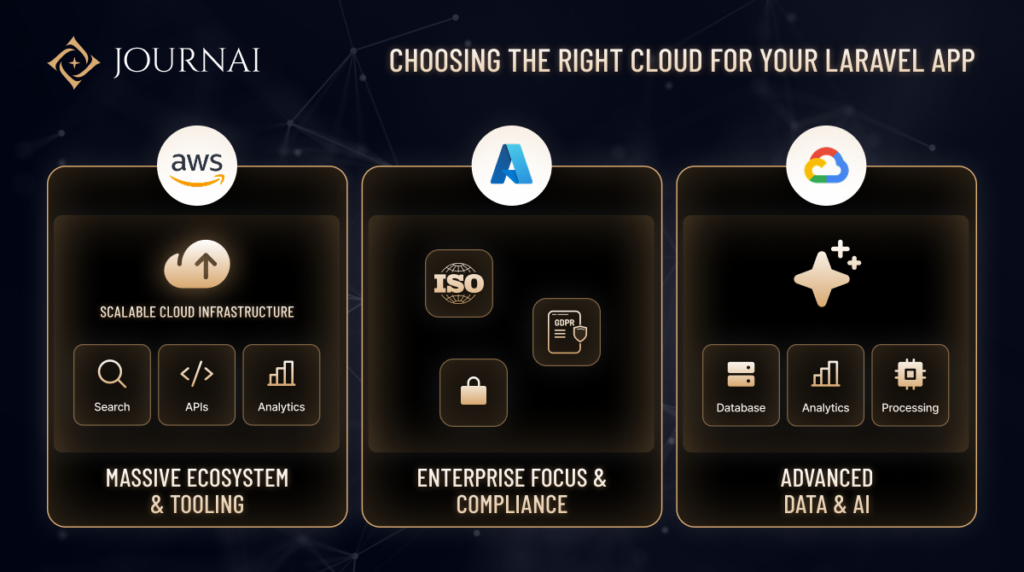
It turned out to be two things: a signed compliance questionnaire and a private network configuration for their data. Neither required leaving AWS. Azure would have satisfied the client’s comfort level, but so would a properly scoped VPC and a security review — at a fraction of the cost and none of the migration risk.
That’s usually how it plays out once you strip the emotion out of the decision:
None of these are permanent. Laravel’s architecture is portable enough that a well-built application can move providers later without a full rebuild, but only if it was designed with that portability in mind from day one, not bolted on during a panic.
The product is still on AWS. The enterprise deal closed anyway, compliance questionnaire and all, and the co-founder’s Azure worry quietly resolved itself once it had an actual answer instead of a guess. Nothing about the infrastructure changed. What changed was that someone finally asked what the client needed, instead of assuming what the client’s logo implied.
That’s the pattern we see over and over with growing Laravel products: the cloud provider is rarely the real problem. The real problem is making an infrastructure decision without first understanding the business reason behind the pressure to make it.
If you’re staring down an AWS-versus-Azure-versus-GCP decision for a Laravel application — whether it’s driven by a client, a cost review, or just a nagging feeling that your current setup won’t scale, that’s exactly the kind of conversation our team at JournAI has every week. From custom Laravel development to Laravel DevOps and infrastructure planning, we help teams separate the real requirements from the noise before committing to a cloud strategy. Get in touch with our Laravel Expert to talk through your Laravel application’s cloud roadmap.
The product is still on AWS. The enterprise deal closed anyway, compliance questionnaire and all, and the co-founder’s Azure worry quietly resolved itself once it had an actual answer instead of a guess. Nothing about the infrastructure changed. What changed was that someone finally asked what the client needed, instead of assuming what the client’s logo implied.
That’s the pattern we see over and over with growing Laravel products: the cloud provider is rarely the real problem. The real problem is making an infrastructure decision without first understanding the business reason behind the pressure to make it.