Back to Blog Page
Ensuring Your Software Communicates Reliably With Stripe, Twilio,...
September 08, 2026

A developer opens an AI coding tool and types:
“Build a login system with authentication.”
A few seconds later, there is code on the screen.
It looks impressive.
Then the developer notices something.
The application already has an authentication system. The project uses a specific database structure. There are existing APIs, coding conventions, security rules, and business requirements that the AI knows nothing about.
The prompt wasn’t necessarily bad.
The problem was the context.
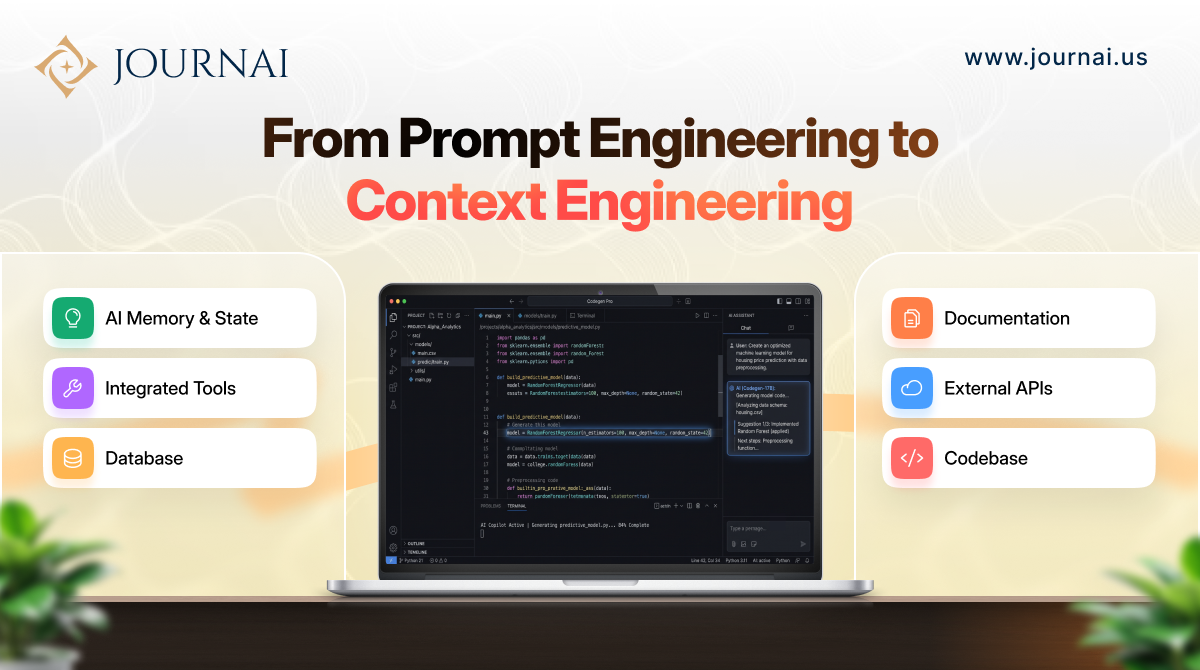
This is where AI development is starting to move beyond prompt engineering.
For the last few years, developers have focused on learning how to ask AI better questions. But as AI systems move from answering individual questions toward operating as agents, assistants, and software development partners, another skill is becoming increasingly important: context engineering.
Anthropic describes context engineering as the broader practice of curating the information available to a model at inference time—including instructions, tools, external data, message history, and other relevant information.
And that shift changes how we should think about building with AI.
Prompt engineering became popular because the difference between a vague request and a well-structured request could dramatically change an AI’s response.
Compare:
“Write a Laravel API.”
with:
“Create a Laravel REST API for customer registration using Laravel validation, API resources, authentication middleware, and JSON responses. Include validation errors and follow REST conventions.”
The second prompt gives the model a much clearer direction.
That’s still useful.
Prompt engineering isn’t disappearing. In fact, clear instructions remain an important part of building reliable AI applications.
But there is a limit.
A prompt can tell an AI what you want.
It cannot automatically give the AI everything it needs to understand why you want it, what already exists, what constraints apply, and what happened earlier.
That’s where context becomes important.
Imagine an AI coding agent working inside a real software project.
It doesn’t just need your latest question.
It may need:
Giving the model all of this information isn’t automatically better either.
Too much irrelevant information can make the context harder to manage and increase cost and complexity.
Anthropic’s guidance makes this point clearly: effective context engineering is about finding the smallest set of high-signal information that gives the model what it needs to produce the desired result.
The skill is no longer just writing the perfect instruction. It’s deciding what the AI should know at the moment it acts.
This becomes even more obvious when we look at AI agents.
A traditional chatbot might receive a question and produce an answer.
An agent can potentially:
That means the AI’s input is constantly changing.
A tool call can add new information.
A database lookup can change what the model knows.
A previous action can affect the next decision.
Context engineering therefore becomes an ongoing process rather than a one-time prompt-writing exercise.
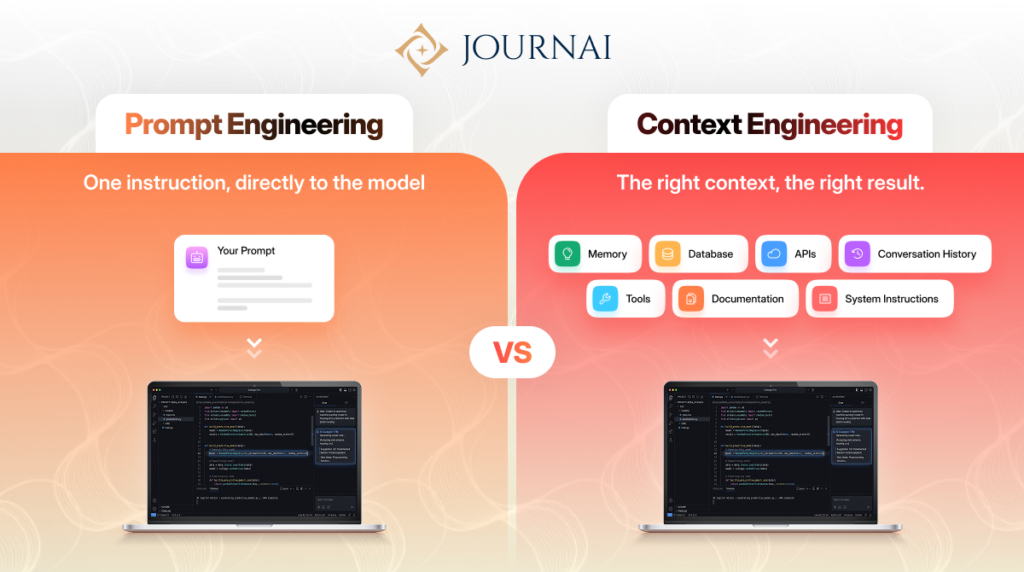
Prompt engineering asks:
“What should I tell the model?”
Context engineering asks:
“What should the model know right now?”
That is a much bigger engineering problem.
The transition is happening because developers are using AI much more frequently—but increased usage doesn’t automatically mean increased trust.
The 2025 Stack Overflow Developer Survey found that 84% of respondents use or plan to use AI tools in their development process, while 46% said they actively distrust the accuracy of AI outputs.
That gap tells us something important.
Developers aren’t simply asking, “Can AI write code?”
They’re increasingly asking:
“Can I trust the code AI writes in the context of my actual application?”
This distinction matters.
An AI-generated function may be syntactically correct but still violate an application’s architecture. It might use the wrong database relationship, ignore an internal business rule, or introduce a security problem.
Stack Overflow’s 2025 research also found that 66% of developers are frustrated by AI solutions that are “almost right, but not quite,” while 45% said debugging AI-generated code can take more time.
That is exactly where better context can make a difference.
Let’s return to our Laravel example.
Suppose a company asks an AI agent to add a new payment feature.
A basic prompt might say:
“Add Stripe payment integration.”
A context-aware development system could provide the agent with:
Now the AI isn’t starting from a blank page.
It’s working inside the application’s reality.
That’s a fundamentally different development experience.
For teams building production software, this is where Development Services and AI development solutions can start working together more effectively. AI can accelerate implementation, while experienced software Developers remain responsible for architecture, security, validation, and business decisions.
This is perhaps the biggest change.
Previously, developers mainly thought about:
Code + Database + APIs + Infrastructure
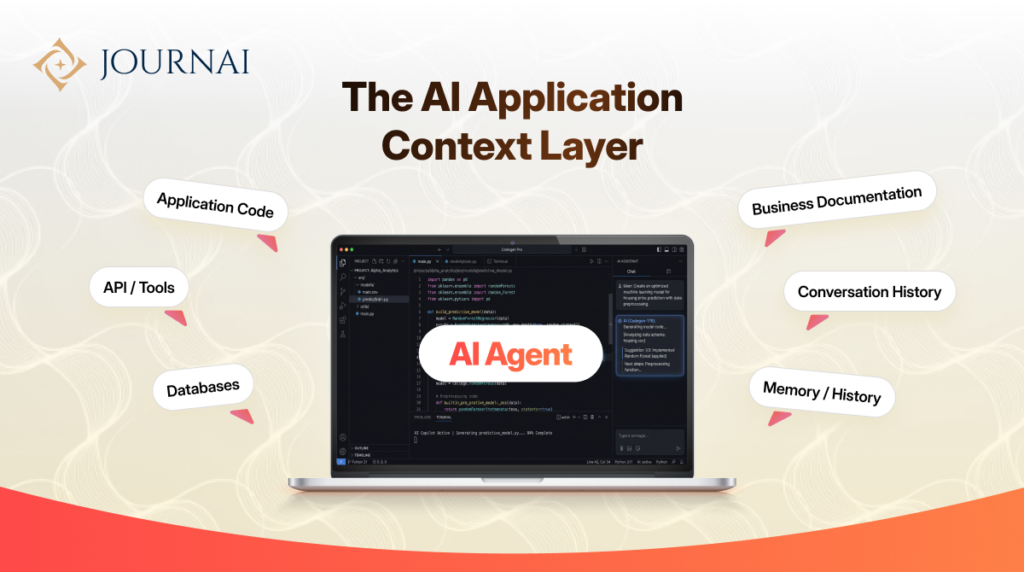
AI-native applications increasingly add another layer:
Context + Models + Tools + Memory + Data
The quality of that context can directly influence the quality of the AI’s decisions.
Anthropic’s research on AI agents also highlights that tools themselves need to be designed differently because agents depend on tool descriptions and returned information to determine what to do next.
So context engineering isn’t simply about stuffing more information into an AI prompt.
It involves designing the entire information flow around the model.
This doesn’t mean every developer suddenly needs to become an AI researcher.
But the developer skillset is expanding.
The next generation of AI-focused developers will need to understand how to:
And perhaps most importantly, developers need to understand the application itself.
Because AI becomes more useful when it understands the environment in which it is operating.
This is especially relevant for companies building custom software. A generic AI assistant may know programming concepts, but it doesn’t automatically know your company’s workflows, customers, architecture, policies, or technical decisions.
That’s why context becomes valuable intellectual infrastructure.
There is an important distinction here.
Context engineering isn’t replacing prompt engineering in the same way smartphones didn’t replace computers overnight.
Instead, prompt engineering is becoming one component of a larger discipline.
You still need clear instructions.
You still need good system prompts.
You still need to tell an AI what success looks like.
But now you also need to decide which information should surround those instructions.
The best AI systems won’t necessarily have the longest prompts.
They’ll have the most useful context at the right moment.
For businesses, this shift has a practical consequence.
Building an AI feature shouldn’t start with:
“Which AI model should we use?”
A better question is:
“What information does the AI need to make a reliable decision?”
From there, teams can design the data, APIs, permissions, memory, tools, and application architecture around that requirement.
Whether you’re adding an AI assistant to an existing product, building an AI-powered SaaS platform, or integrating intelligent workflows into a Laravel application, the underlying software architecture still matters.
A strong Custom Software Development Company can help create the application foundation, APIs, authentication, databases, integrations, and backend services that an AI layer depends on.
The AI may be the visible part.
But the surrounding system is what makes it useful.
A year ago, knowing how to write a good prompt could give a developer an advantage.
Today, that is becoming table stakes.
The next advantage is understanding how to build systems where AI receives the right information, from the right sources, at the right time.
That’s context engineering.
And as AI agents become more capable, this skill will become increasingly connected to traditional software engineering—not separate from it.
The future isn’t simply about humans writing better prompts.
It’s about humans designing better environments for AI to work inside.
AI can generate code quickly. But production software still needs thoughtful architecture, secure integrations, reliable APIs, and developers who understand the bigger picture.
As a top-notch software development company, we combine modern AI capabilities with proven Web Development Services to help businesses build scalable, secure, and AI-ready applications.
Whether you need Custom Software Development Services, AI integrations, API development, or experienced Developers for Hire, we can help turn an idea into a production-ready product.
Ready to build software that is prepared for the next generation of AI?