Back to Blog Page
From Prompt Engineering to Context Engineering: The Next...
September 14, 2026


When you engage a development agency, you’re not just buying hours of programming time. You’re investing in intellectual property that should become a core business asset. Yet many agencies bury clauses in their contracts that grant you only a limited license to use “their” code, retaining full ownership themselves.
The implications are staggering. One healthcare SaaS company we consulted with had spent $280,000 over two years with an offshore agency, only to discover they couldn’t migrate their application to new infrastructure without paying an additional around $75,000 “transfer fee.” The agency owned the codebase. The company owned nothing but a usage license – and a hard lesson about reading contracts.
This isn’t an isolated incident. A 2024 survey by the Software Development Association found that 37% of enterprises had experienced disputes over code ownership with development vendors, with the average cost of resolution exceeding $150,000 approx. in legal fees and engineering work.

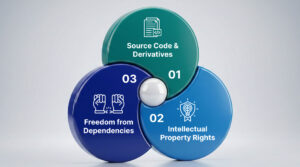
Complete code ownership encompasses three critical components that every enterprise must secure:
You should own every line of code written for your project, including algorithms, custom frameworks, API integrations, and internal tools. This extends to documentation, database schemas, architecture diagrams, and testing suites. If it was created specifically for your project and funded by your budget, you should own it outright.
Ownership means the unrestricted right to modify, distribute, sell, or even open-source the code. You should be free to hire another development team, bring development in-house, or merge the codebase with other systems. No approvals required. No licensing fees. No restrictions.
True ownership means independence from the original development partner. Your code should be deployable on any infrastructure, maintainable by any qualified developer, and free from proprietary frameworks or dependencies that tie you to a single vendor.
When JournAI delivers a project, we transfer 100% ownership through explicit intellectual property assignment clauses. No licenses. No limitations. No future leverage over your business decisions.
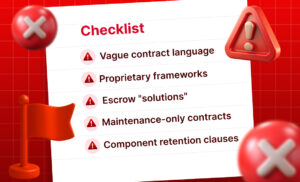
Sophisticated agencies have developed increasingly subtle ways to maintain control over your codebase. Here are the warning signs that should trigger immediate concern during vendor evaluation:
Watch for phrases like “perpetual license to use,” “rights to operate the software,” or “unlimited access.” These terms sound generous but leave ownership ambiguous. If the contract doesn’t explicitly state “full assignment of intellectual property rights,” you don’t own the code.
Some agencies build projects on their own custom frameworks or “platforms,” creating technical dependency even if you have legal ownership. You’re locked into their ecosystem because migrating would require a complete rebuild. At JournAI, we build on Laravel – the world’s most popular PHP framework – ensuring your code is maintainable by thousands of qualified developers worldwide.
Code escrow arrangements sound protective but often mask ownership issues. Why would you need escrow for code you fully own? Escrow is typically offered when the agency retains ownership but promises access under certain conditions – another form of rental.
Agencies that won’t allow other teams to touch “their” code are revealing their true position. If they claim modifications by external developers will void warranties or support agreements, they’re asserting de facto ownership through operational control.
Some contracts grant ownership of custom features while retaining rights to “reusable components” or “framework elements.” This creates ambiguity about what you actually own and often renders the codebase unusable without those components.
The ramifications of weak code ownership extend far beyond legal technicalities. They fundamentally alter your strategic options and company valuation.
During due diligence for acquisitions or funding rounds, investors scrutinize IP ownership. Licensed software appears as a liability, not an asset. We’ve seen acquisition deals collapse when buyers discovered the target company didn’t own their core technology platform. One fintech startup in our network lost around $12M acquisition opportunity because their “custom” trading platform was technically owned by their development agency.
Business requirements change. Markets shift. Strategies evolve. When you don’t own your code, adapting becomes prohibitively expensive. Every significant change requires negotiation with your development vendor, who now has leverage over your timeline and budget. You’re no longer making business decisions – you’re managing a hostage situation.
Unable to bring in alternative development resources, you’re stuck with your original vendor even as their quality declines or pricing increases. Poor-performing agencies exploit this dependency, knowing you have no practical alternative. The technical debt compounds because you can’t hire better teams to refactor and improve the codebase.
Your competitors who own their code can iterate rapidly, experiment with new features, and respond to market opportunities. You’re stuck in a vendor dependency loop, always asking permission, always facing delays, always paying premium rates for changes that should be routine.
Our intellectual property transfer is explicit, comprehensive, and designed to maximize your strategic flexibility. Here’s what you should demand from any development partner:
Our contracts state: “All work product, including source code, documentation, designs, and related materials, created by JournAI for Client shall be considered ‘work made for hire’ and shall be the exclusive property of Client.” No ambiguity. No loopholes.
We deliver comprehensive technical documentation including architecture diagrams, API documentation, database schemas, deployment procedures, and developer onboarding guides. You’re not just getting code – you’re getting everything needed for complete independence.
We build on industry-standard, open-source technologies: Laravel for backend, React or Vue for frontend, PostgreSQL or MySQL for databases, AWS or standard cloud platforms for infrastructure. Every component is well-documented, widely supported, and replaceable without vendor lock-in.
We offer optional ongoing support and maintenance, but we design for independence from day one. You can take the code anywhere. You can hire anyone to maintain it. Your business continuity doesn’t depend on our availability.
We write clean, well-commented code following industry best practices (PSR standards for PHP, ESLint configurations for JavaScript). This isn’t just about ownership – it’s about delivering code that other developers can actually work with when you expand your team.
Before signing with any development partner, have your legal team review the intellectual property clauses. Don’t accept vague language. Don’t settle for licenses when you should have ownership. Don’t build your business on rented foundations.
Ask these specific questions during vendor selection:
The right answers are straightforward and unambiguous. Anything else is a red flag.
Custom software development is a significant investment. For most enterprises, it’s a six-figure or seven-figure commitment. That investment should produce an asset you own, control, and can leverage for competitive advantage.
Don’t settle for rental agreements disguised as development contracts. Don’t build your business on someone else’s property. Demand true ownership, or find a partner who understands that your success depends on your independence.
At JournAI, we believe the code we write for you should be yours – completely, permanently, and without qualification. Because we’re not building dependencies. We’re building the foundation for your next decade of growth.
Ready to build software you actually own? Schedule a discovery call to discuss your project and review our standard IP assignment terms. No obligations, no sales pressure – just transparent conversation about building your strategic technology assets the right way.