The Incident That Should Concern Every CTO Reading This
In April 2023, a Fortune 500 insurance firm publicly disclosed a compliance failure that resulted in a regulatory fine. The root cause, buried deep in their post-mortem: manual data re-entry from policyholder documents into their internal claims management system. A single transposed digit on a claimant’s date of birth created a cascading error that took nine months to surface. No one owned that workflow. No system flagged it. The bug wasn’t in the code — it was in the human process the code was built around. This is not an unusual story. It is the norm. Enterprise operations teams worldwide still process millions of records each year through a combination of copy-paste, re-keying, and manual reformatting. And in 2026, that is no longer a productivity problem. It is a strategic liability. Natural Language Processing — NLP — is the technology that sits between the chaos of unstructured human input and the structured precision that enterprise software demands. This article explains what NLP actually does inside an operations context, why off-the-shelf integrations consistently fall short for complex enterprise use cases, and what a custom-built NLP layer looks like in practice.
What Your Operations Team Is Actually Dealing With
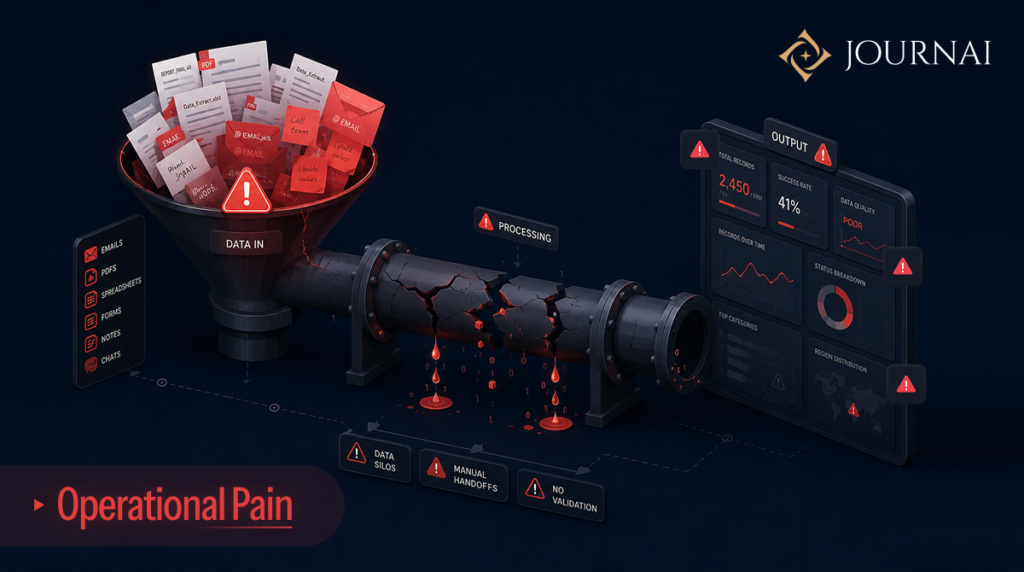
Before getting into the technology, it helps to name the specific pain points that NLP addresses — because each one has a direct cost.
Manual entry creates invisible technical debt
Every time a team member rekeys data from a PDF into a CRM field, or copies figures from an email into a reporting spreadsheet, that act introduces a failure point with no audit trail. When the error surfaces — sometimes weeks or quarters later — nobody owns it. Debugging it requires reconstructing a decision chain that existed only in someone’s head or inbox. This is not a training problem. It is an architectural one. The system was not designed to capture and validate intent at the point of entry.
Risky updates that nobody scheduled
A common scenario in mid-market and enterprise SaaS environments: the vendor updates their document export format or email notification template. Suddenly, the fragile parsing script that the internal team wrote breaks silently. Data still appears to flow — but it is now flowing into the wrong fields, or being dropped entirely. Nobody notices until a downstream report produces numbers that nobody can explain. This is a category of failure that NLP, properly implemented, can make structurally impossible — because it parses meaning rather than pattern-matching fixed string positions.
Slow releases caused by data quality reviews
Engineering teams at scale spend a disproportionate percentage of sprint capacity on data validation and cleanup tasks. According to IBM’s 2022 Cost of Data Quality report, organizations spend an average of over thirty percent of their data team’s time correcting bad data — data that arrived through manual entry or brittle integrations. This is time that was originally budgeted for product development.
What NLP Actually Does — Without the Jargon
Natural Language Processing is a branch of AI that enables software to understand, interpret, and act on language the way humans write and speak it — not just pattern-match specific keywords. In an operations context, this means your system can:
- Read an inbound vendor invoice written in freeform English and extract line items, amounts, due dates, and contract references — without needing a fixed template
- Parse customer support emails to classify urgency, identify the product SKU being referenced, and pre-populate a ticketing record — without human triage
- Process handwritten or voice-transcribed field notes from a logistics team and convert them into structured database entries in real time
- Understand that ‘Q4 delivery confirmation from Singh’ and ‘Delivery Note — Rajesh Singh — October 31’ are the same entity across two different document formats
The key distinction from older rule-based automation (like regex parsing or template matching) is contextual understanding. NLP models understand that ‘the client cancelled’ and ‘client has withdrawn the order’ mean the same thing, even though they share no common keywords.
The Real-World Case: How a US Logistics Firm Eliminated Its Biggest Operational Risk
A mid-sized US freight and logistics company — processing roughly 12 thousand shipment records per week — came to JournAI with a specific and urgent problem. Their operations team was spending an estimated 22 hours per week manually transcribing delivery confirmations from carrier emails, WhatsApp messages, and scanned PODs (proof of delivery documents) into their core logistics management system. The error rate was manageable on its own. The real problem was that when discrepancies appeared — a shipment marked delivered in the carrier’s system but unconfirmed in theirs — nobody could resolve it quickly. The data lineage was nonexistent. Investigations required pulling email threads from three different inboxes and matching timestamps manually. The outcome of the JournAI NLP integration:
- A custom document intelligence layer trained on their specific carrier formats, email conventions, and internal classification taxonomy
- Automated extraction and validation of delivery confirmations with a structured confidence score — flagging only genuine ambiguities for human review
- Full audit trail on every extracted data point, traceable back to the original source document
- Release cycle impact: the operations team’s sprint backlog related to data cleanup dropped by over seventy percent within the first quarter of deployment
The engineering team stopped being a data rescue squad. They became a product team again.
Why Off-the-Shelf NLP Tools Fall Short for Enterprise Use Cases
The SaaS NLP market is crowded. Microsoft Azure AI Language, Google’s Document AI, Amazon Comprehend — these are mature, capable platforms. So why do enterprise teams with complex operations find them insufficient?
They are built for breadth, not depth
Generic NLP platforms are optimized to work reasonably well across millions of use cases. Your operations team does not need to be reasonably well. They need a model that understands the specific shorthand your procurement team uses, the document structures from your specific partners, and the internal classification logic your compliance team has developed over the years.
They create new integration dependencies
When you connect your core operations platform to a third-party NLP API, you are introducing a new failure point with its own uptime SLA, versioning schedule, and deprecation risk. In April 2024, Google announced the deprecation of the AutoML Natural Language API with a twelve-month sunset window. Organizations that had built operational workflows on that API had to begin emergency re-architecture on someone else’s timeline — not theirs.
They do not own the data context
Generic models do not know your business. They cannot be told that when your operations team writes ‘confirmed via portal,’ it means a specific three-step approval workflow was completed. That business context lives inside your organization and requires a custom model fine-tuned on your data.
What a Custom NLP Integration Actually Looks Like
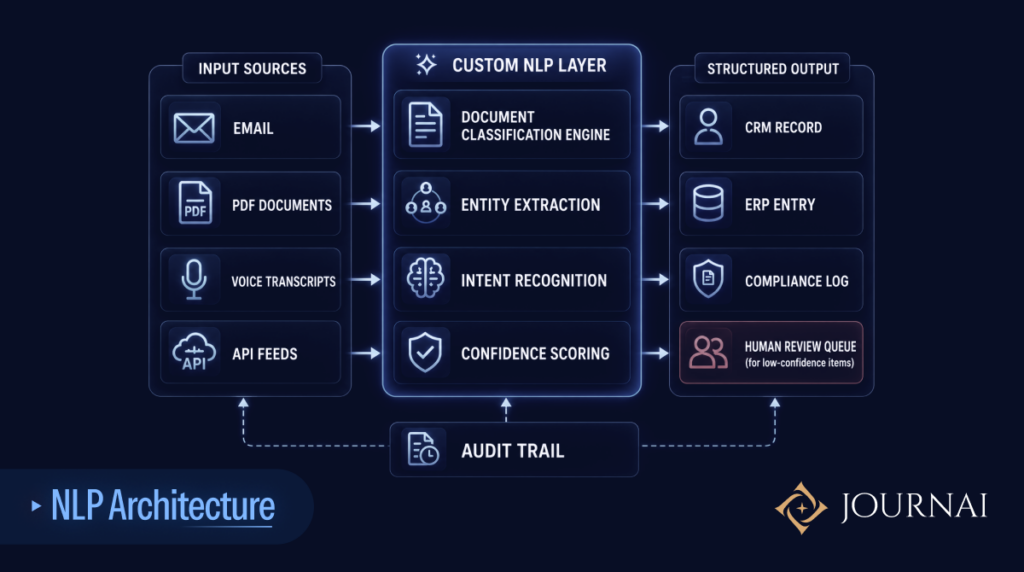
A custom NLP built at JournAI for an operations use case typically follows a defined architecture pattern:
Discovery and taxonomy definition
Before any model training begins, we map your operational data landscape: what documents and inputs does your team process, what entities matter (dates, names, amounts, product codes, status flags), and what decisions are being made downstream based on that data. This phase determines the scope of automation and the human-review thresholds.
Model training on proprietary data
We train the NLP layer on a representative sample of your actual historical documents and inputs. Not generic web text. Your vendor invoices, your customer emails, your internal reports — in the language and format your organization actually uses.
Confidence-tiered output
Every extracted data point receives a confidence score. High-confidence extractions flow directly into the target system. Lower-confidence extractions are routed to a human review queue with a pre-populated suggestion, not a blank form. This approach reduces manual work without creating a false sense of full automation.
Integration into your existing stack
The NLP layer does not replace your core operations platform. It sits in front of it — processing inputs before they reach your database, enforcing data quality at the entry point rather than correcting errors downstream.
Monitoring and drift detection
Operational language evolves. New vendors, new document templates, new internal terminology. A production NLP system requires ongoing monitoring for accuracy drift — flagging when the model’s confidence on a specific document category starts declining, which signals that the source format has changed.
The Ownership Question That Most Teams Avoid
There is a conversation that almost never happens during NLP vendor selection, and it is the most important one. Who owns the model? When you deploy a third-party NLP SaaS tool, the model weights, the training data, and the configuration live on the vendor’s infrastructure. If they change their pricing, alter their output schema, or get acquired, your operational workflow is hostage to that decision. A custom-built NLP layer, trained on your data and deployed in your infrastructure, is a business asset. It appreciates over time as more data is fed into it. It cannot be deprecated by a vendor announcement. And it can be audited, explained, and modified by your
dedicated development team or a technology partner you trust. In regulated industries — healthcare, financial services, logistics — this is not a preference. It is a compliance requirement in most jurisdictions.
How to Know If Your Operations Team Is Ready for NLP
Not every manual process is an NLP opportunity. The clearest signals that NLP will deliver measurable ROI in your operations:
- Your team processes a significant volume of unstructured inputs (emails, documents, forms, messages) on a recurring basis
- Data quality issues in your operations system are traced back to entry errors rather than system bugs
- A meaningful portion of your engineering team’s sprint capacity is consumed by data validation, cleanup, or migration tasks
- You have experienced incidents where a vendor’s document format change broke an internal process
- Your compliance or audit team cannot trace a data point back to its original source
If more than two of these apply, you are experiencing a solvable problem. The question is whether you address it architecturally now or wait for the incident that forces the conversation.
What This Means for Your 2026 Technology Roadmap
The enterprise software landscape in 2026 is moving toward what analysts are calling ‘ambient intelligence’ — the idea that AI processing should be invisible and continuous, embedded into existing workflows rather than deployed as a standalone tool that requires user adoption. NLP for operations is one of the most mature and immediately deployable expressions of this vision. The technology is proven. The use cases are documented. The risk is not in the AI — it is in building on the wrong foundation. Organizations that invest in custom NLP infrastructure in 2026 are building operational resilience. Those who continue patching manual workflows are accumulating a liability that will surface, eventually, at the worst possible moment. The question worth asking your operations and engineering leadership this quarter is not whether NLP is relevant to your business. It is whether the cost of the status quo — in errors, in sprint capacity, in compliance exposure — is acceptable for one more year.
About JournAI: We build
custom AI-powered software for enterprise and growth-stage businesses. Our NLP development practice is focused on operations-critical workflows where data quality and system reliability are non-negotiable. If you are evaluating NLP integration for your operations stack, we offer a structured discovery process to assess fit and define scope before any development begins.
 Back to Blog Page