The AI MVP: How to Launch an AI-Powered Product in Under 90 Days Without Watching It Fall Apart on Day One
What if the most dangerous moment in your product’s life isn’t the launch — it’s the morning after? Hundreds of enterprise teams greenlight an AI MVP with the same shared excitement. The pitch deck lands. The stakeholders nod. The timeline looks clean on paper. And then, somewhere between demo day and real-world users, something quietly breaks. It isn’t always a dramatic crash. Sometimes it’s a slow bleed — a report that nobody trusts anymore, an automation that keeps throwing exceptions nobody owns, a release that gets pushed by another two weeks because QA found something critical the night before go-live. This piece is for the teams who are serious about building an AI MVP that survives contact with reality. Not a prototype. Not a demo. An actual product.
According to McKinsey’s 2025 State of AI report, 88% of organizations now use AI regularly in at least one business function — up from 78% in 2024. Yet a growing share report their AI initiatives stalled before reaching production. 
So What Actually Goes Wrong?
Ask any VP of Engineering who has been through a failed AI initiative, and you’ll hear the same patterns repeated with different company names attached to them. The bugs don’t appear in staging. They appear at scale, on a Tuesday, in front of the client who just renewed their enterprise contract. The downtime isn’t scheduled — it’s the update that nobody tested properly because the sprint deadline was already slipping. The risky update gets pushed because someone is under pressure from above, and when it breaks, nobody is quite sure who owns the problem. This is the hidden cost of treating AI MVP development as a sprint rather than a system design challenge. Take what happened at a mid-size logistics company in 2024. They integrated a predictive routing AI into their dispatch platform through an offshore team. The AI MVP looked remarkable in internal demos. It processed historical route data, suggested optimized paths, and reduced manual dispatcher decisions by a projected forty percent. Three weeks into live deployment, an edge case in their freight weight dataset started triggering calculation errors. The AI was routing trucks incorrectly. Dispatchers lost trust in the system overnight. The rollback took eleven days because nobody had documented the deployment architecture. Nobody owned it. That is not an AI problem. That is an architecture and ownership problem dressed up as an AI problem.
What Does a Well-Built AI MVP Actually Look Like?
Before anything is written in code, a proper
AI MVP development process begins with a question that most teams skip: What happens when this is wrong? Because AI systems are probabilistic by nature. They are not like traditional software, where a function either returns the correct value or throws an error. AI outputs require validation layers, confidence thresholds, fallback logic, and human-in-the-loop checkpoints — especially in the first ninety days when real-world data is teaching the model things your training set never anticipated. A properly built AI MVP has three distinct structural layers:
◆ Layer 1 — The Intelligence Core: The actual model or AI logic, whether that is a fine-tuned LLM, a predictive ML model, or a rules-augmented AI engine. This layer is scoped tightly to a single, validated use case. ◆ Layer 2 — The Validation Shell: Output parsing, structured response enforcement, fallback handling, and confidence scoring. This is the layer most teams skip entirely and the layer responsible for ninety percent of post-launch incidents. ◆ Layer 3 — The Observability Stack: Logging, anomaly detection, and rollback pipelines. If you cannot see exactly what the AI decided and why, you cannot fix it when it goes wrong. 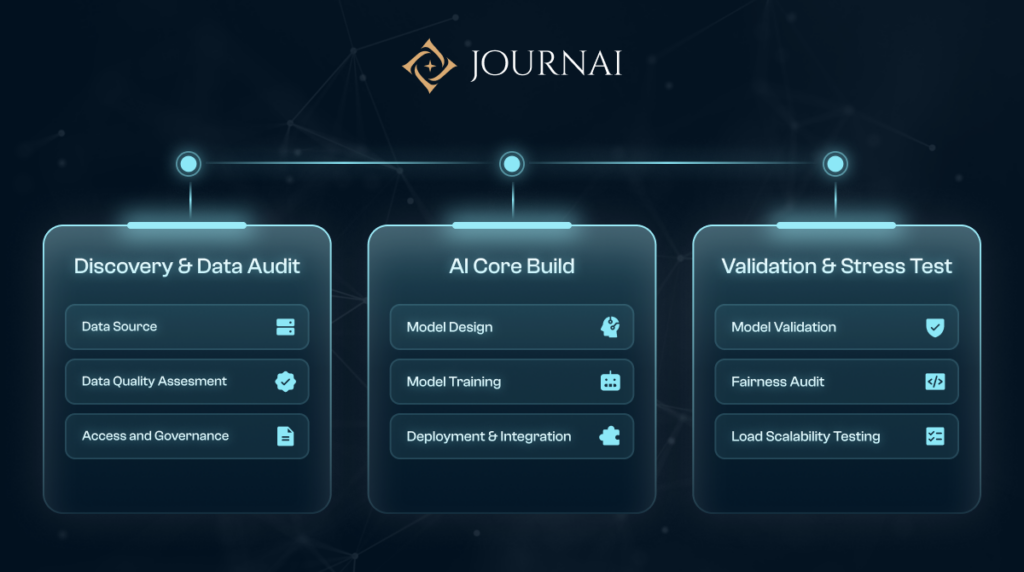
Three Scenarios Where the 90-Day AI MVP Actually Works
The ninety-day mark is not magic. It is the natural boundary of a disciplined AI MVP development cycle when the scope is defined correctly from day one. Here is what that looks like in practice.
Scenario A: Healthcare Operations Automation
A regional hospital network needed to automate the triage routing of incoming patient intake forms — pulling diagnosis codes, flagging incomplete data, and routing to the right department without human review. The AI MVP scope was narrow: intake forms, three departments, one EMR integration. In week one, two weeks of discovery documented every edge case in the existing manual workflow. By week six, the AI core was processing a parallel dataset alongside human reviewers. By week twelve, it was handling sixty percent of volume with a ninety-four percent accuracy rate — and every decision was logged and auditable. The product went live. The audit trail existed. Nobody argued about who owned the system.
Scenario B: E-Commerce Personalization Engine
A B2B marketplace with over ninety thousand SKUs needed to stop losing customers to better personalized competitor platforms. The AI MVP was a recommendation layer — not a full platform rebuild. Scoped to homepage and cart upsell positions only. The AI was trained on twelve months of purchase history. Validation shell tested recommendation relevance against a human-curated baseline before any customer-facing deployment. By week eight, A/B test results showed a measurable lift in average order value. The system was observable, rollback-ready, and code-owned entirely by the client from day one.
Scenario C: Financial Compliance Flagging
A fintech lending platform needed to reduce manual compliance review time on loan applications without increasing regulatory risk. The AI MVP was scoped to flag applications needing additional document review — not to make loan decisions. After a two-week discovery phase that mapped the existing review workflow, the model was built with confidence thresholds that routed low-confidence flags directly to senior reviewers. No edge case was left unhandled. No regulatory exposure was introduced. The platform launched on schedule, passed internal audit, and reduced the compliance review queue by thirty-eight percent in the first quarter. The common thread across all three? Tight scope. Owned architecture. A validation layer that caught what the model missed. And a team that treated post-launch support as part of the product, not a cost center. Visual: A cracked foundation metaphor — a polished skyscraper rendering above ground, but a zoomed-in underground view showing fractured concrete pillars labeled ‘No Ownership,’ ‘No QA Protocol,’ ‘Locked into Vendor.’ One pillar is intact and labeled ‘Custom Architecture.’ Style: dramatic cross-section illustration, dark background with glowing infrastructure lines. Highly visual metaphor for enterprise decision-makers. None of these layers is optional for enterprise-grade deployment. The teams that launch fast and break nothing are the ones who built the validation shell and observability stack before the intelligence core went live.
The Honest Conversation About AI MVP Development Cost
There is a tier of AI MVP development agencies in 2026 that will ship you a working AI product in fourteen to thirty days for a fixed price. For pure proof-of-concept work, that tier exists for a reason. But enterprise-grade AI MVP development — the kind that survives compliance review, scales to thousands of users, and gets maintained by your internal team two years from now — sits in a different tier entirely. It requires a discovery investment upfront. It requires architecture that your team owns, not rents. It requires documentation that does not live in one developer’s head. The organizations that treat AI MVP development as a commodity purchase discover the real cost in the maintenance phase — fixing code built on shortcuts, rewriting logic that was never documented, and managing vendors who hold the deployment keys.
What Should You Actually Validate in the First 90 Days?
The purpose of the AI MVP is not to build a complete product. It is to answer three specific questions under real conditions: ◆ Does the AI logic actually work with real data, not just training data? ◆ Can the validation shell catch the failure modes we didn’t anticipate? ◆ Does the observability stack give us enough signal to improve continuously? If you exit the ninety-day AI MVP development cycle with clear answers to those three questions — even if some answers are ‘no’ — you have succeeded. You have validated the foundation. Everything built on top of it now has a structural chance. If you exit with a product that looks good in the demo but breaks in edge cases, produces outputs nobody trusts, and has no audit trail — you have not launched. You have created a liability.
The Decision That Determines Everything
The single most consequential decision in any AI MVP development process is made before a line of code is written: who owns the architecture? Not the vendor. Not the offshore team. Not the platform you are building on. You. Code ownership is not just a contractual term. It is the operational difference between a product you can evolve, audit, and improve — and a product you are perpetually dependent on someone else to maintain, understand, or fix. The teams building serious AI products in 2026 have already internalized this. The ones still negotiating it in month three are the ones who will be rebuilding in year two.
Where to Start
If you are evaluating an AI MVP for your organization, the first thirty minutes of any serious conversation should answer these questions: What is the single use case we are validating? What does failure look like, and who owns it? What is the output validation strategy? What does the rollback plan look like on day one of production? These are not technical questions. They are strategic ones. And the answers you get in that first conversation will tell you more about the quality of the
AI MVP development partner in front of you than any portfolio page will. The ninety days are not the challenge. The architecture before day one is.
 Back to Blog Page