Scalability by Design: What Happens When Your App Wasn’t Built to Grow
Every company has a version of this story. The marketing team launches a campaign that goes viral. A press mention brings a wave of new signups. A major client onboards and brings their whole team. And then the thing nobody planned for: the app falls over. Tickets pile up. Slack explodes. And somewhere in the office, the phrase “nobody owns this” starts quietly circulating.The Question Nobody Asks Until It’s Too Late
What does your software do at ten times today’s load? If the honest answer is “I don’t know” — you’re already exposed. According to a
2024 report by EMA Research cited by BigPanda, unplanned IT downtime now costs enterprises an average of over fourteen thousand dollars every single minute. For large enterprises, that figure rises to nearly $ 24,000 per minute. And yet most enterprise software teams only start thinking about scalability after the first major incident. This is not a technology problem. It is an architectural decision that was either made intentionally — or ignored until failure forced the answer.
The CrowdStrike Moment That Woke Everyone Up
On July 19, 2024, a single faulty software update from CrowdStrike crashed more than eight and a half million Windows devices worldwide. Airlines went manual. Hospitals activated downtime protocols. Delta Airlines alone reported a revenue loss exceeding 308 million dollars. The technical fix took less than two hours. The operational fallout lasted days. What made that event so devastating was not the bug itself — it was the architecture that allowed one update to propagate instantly to every system with zero isolation, zero canary deployment, and zero circuit breaker in between. As Medium’s The Abstract Engineer noted in an October 2025
analysis of major outages: “Failures teach in ways that no system design textbook can.” The CrowdStrike incident was a graduate-level class in what scalability and resilience architecture is supposed to prevent. The question for your organization is not whether something like that could happen to you. The question is: if it did, how far would the damage travel?
Real Scenario A mid-size logistics SaaS platform signed its largest enterprise client — a retail chain with 11 regional warehouses. Their onboarding brought 1500 concurrent users on day one, triple the previous peak. By noon, queries were timing out, the job scheduler was deadlocked, and the customer’s operations team was on a bridge call with the CTO demanding answers. The root cause was not a new bug. It was a database connection pool that had never been sized for concurrent enterprise load. The app was perfectly healthy — until it met success.
What ‘Scalability by Design’ Actually Means
The phrase gets thrown around freely. But in practice, designing for scalability means making specific, deliberate architectural decisions before the first line of code is written — not as an afterthought when a client starts growing. At JournAI, scalability is treated as a non-negotiable requirement in the Discovery Phase. Every application we build is evaluated against five architectural dimensions from day one:
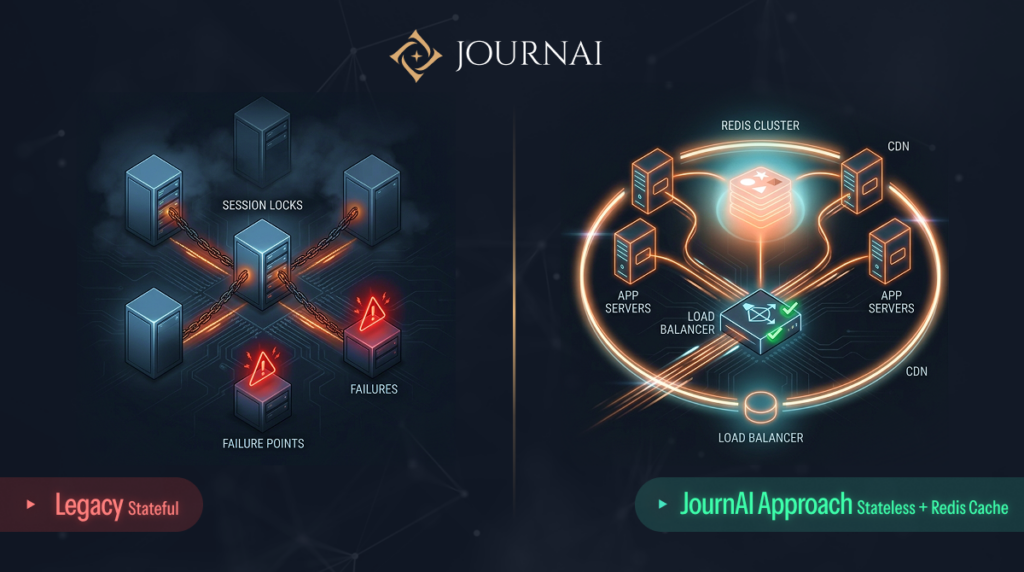
Stateless Application Layers
When application servers hold session state locally, scaling horizontally becomes nearly impossible. Every new instance is a liability. We architect applications so that session state lives in a distributed cache layer — Redis or a managed equivalent — meaning any server can handle any request at any time. This is the difference between an app that can handle one load balancer and one that can handle fifty.
Database Architecture That Doesn’t Become a Bottleneck
The single biggest scalability killer in
custom enterprise software development is a poorly designed database layer. Read-heavy workloads need read replicas. Write-intensive operations need proper indexing strategies and — when needed — sharding. We design the data model to support the eventual load, not just the launch-day scenario. Airbnb’s early infrastructure problems, documented widely in engineering retrospectives, showed exactly this failure mode: their database became the single point of failure as user numbers climbed, causing cascading timeouts that their front-end was completely powerless to prevent.
Event-Driven Architecture for Non-Blocking Operations
Imagine your enterprise platform triggers an email notification, generates a report, and updates a third-party CRM — all synchronously in a single API response. Under light load, that response takes 400 milliseconds. Under load, it takes forty seconds. And then it times out. We break non-critical operations into async event queues. The core transaction completes instantly. Background workers pick up the downstream tasks independently. This is not complexity for its own sake — it is the difference between a response time that scales with your users and one that degrades the moment volume increases.
Risky Updates Don’t Have to Be Risky
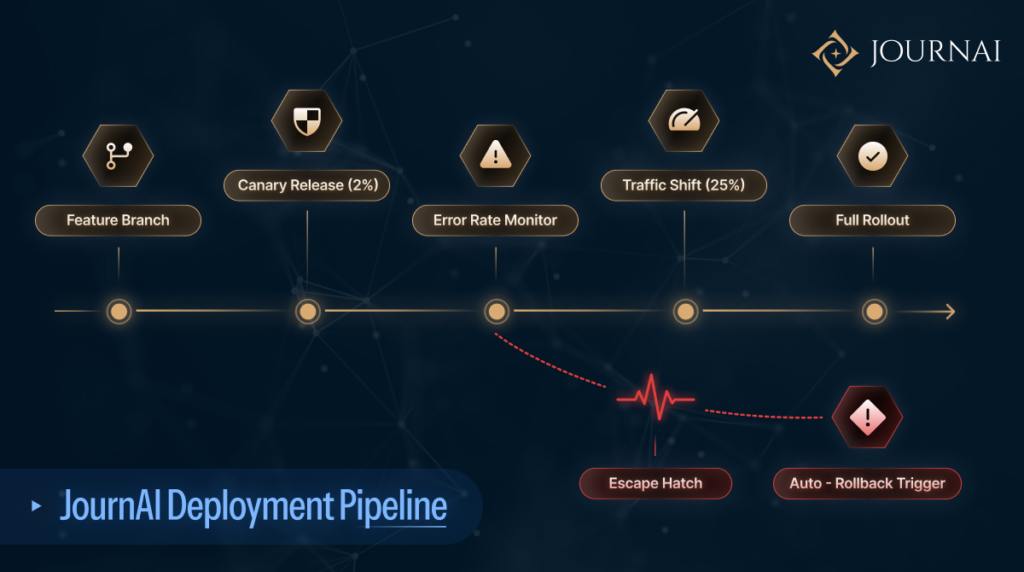
One of the most common fear statements we hear from enterprise engineering leaders: “We haven’t deployed in 6 weeks because last time we deployed, something broke in production and we spent 3 days rolling back.” Slow releases are not a discipline problem — they are an architecture problem. The JournAI deployment pipeline includes feature flags, canary releases to a small slice of production traffic, automated rollback triggers tied to error rate thresholds, and isolated environment parity between staging and production. A new release goes to two percent of users first. If error rates stay flat, traffic shifts gradually. If they spike, the rollback is automatic. Nobody has to own the panic — the system handles it.
Infrastructure Elasticity — Scaling Out, Not Just Up
Vertical scaling — putting more CPU and RAM on a single machine — has a hard ceiling and a single point of failure. Horizontal scaling — adding more instances behind a load balancer — is how
modern enterprise applications absorb traffic spikes without incident. Every application we deploy is containerized and designed to run on auto-scaling infrastructure. When your platform gets featured in a major industry publication and traffic triples overnight, the infrastructure responds before any customer notices. When the spike passes, it scales back down — and your infrastructure bill reflects actual usage, not worst-case provisioning.
The ‘Nobody Owns It’ Problem — And Why It Destroys Scalability
There is a failure mode that has nothing to do with code quality. It is a human and organizational failure that shows up in almost every legacy application we inherit: nobody fully owns the system. The original developers have moved on. The internal team knows how to use it but not how it works. The documentation is three years out of date. And when something breaks at scale — when a query starts taking thirty seconds instead of 300 milliseconds — nobody can explain why.
Real Scenario A healthcare technology company came to JournAI after their internal team spent eleven weeks investigating a performance degradation that only appeared when over 500 users were concurrently active. The root cause turned out to be an N+1 query buried in a reporting module — a database anti-pattern that executes one query per row instead of batching. Under light load, it was invisible. Under enterprise load, it was catastrophic. The original developer had been gone for two years. Nobody owned it. The JournAI Method addresses this directly through code ownership documentation, architecture decision records, and structured handoff protocols. When we build your application, there is always someone who understands why every architectural decision was made — not just what it does.
What Scalable Architecture Looks Like in Production
The proof is not in architecture diagrams — it is in what happens when something unexpected occurs. Here is what a well-architected enterprise application looks like under pressure: ▸ A traffic spike happens. Auto-scaling adds instances within 90 seconds. No alert fires. No customer notices. ▸ A database query suddenly slows down. Query performance monitoring fires an alert before any user timeout occurs. The team investigates proactively. ▸ A third-party payment provider has an outage. The circuit breaker opens, falls back to a queued retry mechanism, and the user sees a graceful ‘processing’ state instead of an error. ▸ A deployment causes an unexpected increase in error rates. The canary release system detects the anomaly and initiates automatic rollback within four minutes. ▸ An enterprise client onboards 5 times more users than projected. The platform absorbs the load. The sales team sends a thank-you note. The engineering team sees nothing unusual in their dashboards.
The Cost of Getting This Wrong
According to a September 2025 New Relic study cited by CIO Dive, IT outages cost businesses a median of $76 million annually — with every minute of operational shutdown costing over $33,000 at the median. For enterprise companies, a single major scalability incident is not just a technical inconvenience. It is a revenue event, a customer churn event, and in regulated industries, a compliance event. Beyond the immediate financial impact, there is the slower and harder-to-measure cost of what happens afterward: the emergency consultants, the rushed re-architecture, the engineering sprint that was supposed to ship the next major feature but instead spent six weeks fixing what should have been built right the first time.
The companies that invest in scalability by design do not pay for it twice. The ones that skip it almost always do.The JournAI Commitment
We do not build software that works today and struggles tomorrow. Every project we take on goes through a scalability review during the Discovery Phase — before a single line of production code is written. We define load assumptions, stress-test the architecture against projected peak scenarios, and build the deployment infrastructure that allows your team to ship confidently without fear. Because the most expensive engineering you will ever do is rebuilding something that should have been designed correctly the first time. Want to know if your current architecture is built to scale?
Book a free Architecture Review Call with the expert Enterprise Software team. Back to Blog Page