Back to Blog Page
The Model Works. The Business Still Can’t Use...
October 13, 2026


There is a meeting that happens inside almost every scaling enterprise. It gathers product managers, engineering leads, maybe a CTO, and sometimes the head of sales. Everyone arrives with a list. No one leaves with a plan.
The backlog keeps growing. The sprint keeps shrinking. Customers keep asking why that one feature — the one promised last quarter — still isn’t live.
This is not a people problem. It is a prioritization problem. And it is costing enterprise teams more than they realize – in delayed revenue, in engineer attrition, in customer churn that never gets attributed to the right root cause.
Real Talk: According to a Gartner study, enterprise software teams spend an average of 35% of their annual development capacity building features that either go unused or get deprecated within eighteen months. The problem isn’t velocity. It’s direction.
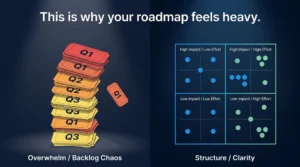
Here’s a scenario that may feel familiar. A customer success rep escalates a client request — it gets logged. Sales promises a feature to close a deal — it gets logged. The CEO returns from a conference inspired — it gets logged. Engineering flags a critical infrastructure risk — it gets logged.
By Q2, the backlog has grown past the point where any single person understands it.
By Q3, engineers are making priority calls based on whoever shouted loudest last week.
By Q4, a post-mortem conversation happens: why did we ship seventeen minor UI tweaks while the authentication bug that was causing enterprise clients to call support never got fixed?
Nobody owns it. That is the first and most expensive problem in enterprise feature prioritization.
Real Case: When Basecamp rebuilt its product team structure in 2020, Jason Fried documented publicly that one of their biggest shifts was eliminating the concept of a ‘feature backlog’ entirely. Their rationale: a backlog is a guilt trip, not a strategy. Enterprise teams that treat backlogs as sacred lists tend to spend more time managing the list than building what matters.
Feature prioritization in enterprise environments breaks down in a specific and predictable pattern. Low-risk, low-impact features get shipped often because they are easy. High-risk, high-impact features — the ones that could unlock a new market segment or cut customer support tickets in half — get delayed because they require alignment across teams that don’t naturally talk to each other.
This creates a dangerous inversion. Teams feel productive because they are always shipping. But the things that move the needle for enterprise clients — the integrations, the security upgrades, the workflow automations that justify a six-figure contract renewal — sit in planning limbo for months.
Meanwhile, a risky update that bypassed proper review causes an incident. Downtime hits. An enterprise client who processes payroll on your platform calls their account executive at midnight.
Real Case: In 2021, Robinhood suffered a multi-day outage during peak trading activity. Post-incident analysis revealed that insufficient change review processes — partly a result of prioritizing feature velocity over infrastructure stability — contributed to the failure. The cost extended far beyond engineering: regulatory scrutiny, user lawsuits, and a measurable drop in enterprise partnership discussions followed. A single deprioritized infrastructure item became an existential moment.
Enterprise CTOs often frame slow releases as a capacity problem. If we just had more engineers, we would ship faster. But organizations that double headcount without fixing prioritization just produce twice as many contested tickets.
The actual cause of slow release cycles in enterprise environments almost always comes back to decision-making friction. Features reach code-complete status and then sit in review queues. Review queues sit waiting for stakeholder sign-off. Stakeholders haven’t agreed on the definition of done because nobody aligned on requirements at the start.
The bottleneck is not build time. It is decision time.
Teams that fix prioritization upstream — before a single line of code is written — ship faster downstream, not because engineers work harder, but because engineers work on things that move through review and approval without friction.

Effective enterprise feature prioritization is built on four foundations. These are not theoretical — they are the patterns that separate teams who ship strategically from teams who ship reactively.
Not every feature lives in the same universe. Tier your backlog into three layers: revenue-impact features (directly tied to retention, expansion, or acquisition), stability features (directly tied to uptime, security, and compliance), and enhancement features (nice-to-have improvements with no hard business case).
Every sprint must draw from the first two tiers before touching the third. This single rule eliminates the most common form of backlog drift.
Every feature in your backlog should have a single named human being who is accountable for its business case — not a team, not a department. When a feature has no named owner, it has no advocate, no deadline pressure, and no one who feels the cost of inaction.
Real Case: Atlassian’s product team introduced a ‘Feature Sponsor’ role specifically to address the ownership gap. Each roadmap item above a certain scope threshold requires a sponsor who is not the engineer building it. The result: features with clear sponsors ship at a rate nearly double those without. The accountability creates urgency without adding process overhead.
Enterprise product teams often calculate the cost of building a feature. Almost none calculate the cost of not building it. This asymmetry is what keeps high-value features perpetually in second place behind loud-but-low-impact requests.
A simple cost-of-delay calculation — even a rough estimate of monthly revenue impact per week of delay — transforms how features compete for priority. When the team can see that a security integration is costing an estimated retention risk against enterprise accounts worth significant ARR per month, it stops being a backlog item and becomes a sprint commitment.
The fear that prioritization frameworks will create bureaucracy is legitimate — but misplaced. The goal is not more gates. It is smarter gates.
High-risk changes (schema migrations, authentication changes, billing logic updates) should require a lightweight but mandatory structured review. Low-risk changes (copy updates, UI polish, non-critical configuration changes) should flow through automatically.
Teams that implement tiered release governance reduce their critical incident rate without reducing their release frequency. That is the dual outcome enterprise engineering leaders need to present to boards and investors.

Here is what the enterprise clients on your platform are measuring, even if they haven’t told you explicitly. They need to know that your release process is stable enough to trust at scale. They need confidence that a routine product update won’t cause downtime during their peak business hours. They need to believe that the features you are building are responding to their actual operational pain — not to internal assumptions or competitor mimicry.
Every prioritization decision your team makes is either building or eroding that trust.
The enterprises that renew, expand, and become advocates are the ones who feel like your roadmap was built with them in mind — not despite them.
If your team is reading this and seeing reflections of your own backlog chaos, the starting point is simpler than it looks.
You don’t need to redesign your entire delivery process in a week. You need to make one better decision than you made last sprint. Then another. That is how enterprise teams build the kind of compounding reliability that clients notice, that boards reward, and that engineers stay for.
Key Takeaway: Feature prioritization is not a backlog problem, a tooling problem, or a headcount problem. It is a clarity problem. The teams winning the enterprise market are the ones who have decided — explicitly and permanently — that building the right things matters more than building things fast.