Back to Blog Page
The Model Works. The Business Still Can’t Use...
October 13, 2026


The brief was clear. The deadline was firm. The stakes were real.
A digital health startup — we’ll call them ClearPath Health, a telehealth company focused on chronic care management — came to JournAI in a familiar position. They had a grant window closing, a pilot hospital partner ready to go, and a product that existed only as wireframes and a shared Google Doc. Their previous vendor had just told them the timeline was “unrealistic.”
Eight weeks to a live, HIPAA-compliant patient intake and remote monitoring platform.
Their CTO had a single question: “Can you actually do this, or are you going to tell me the same thing everyone else did?”
We shipped it in fifty-three days.
This is the real story of how — and what every enterprise healthcare decision-maker can take from it.
Before we talk about what we built, let’s talk about why most healthcare software projects fail — not in launch, but long before it.
The pattern is predictable: A healthcare org or digital health startup signs with a development agency. Timelines slip. The team changes three times mid-project. Nobody can give a straight answer on who owns the HIPAA audit trail logic. QA is rushed. The launch is delayed. And six months later, the product is half-baked, the budget is gone, and the clinical team still hasn’t adopted it.
Sound familiar? Here’s what’s really happening beneath the surface:
ClearPath Health had already lived through version one of this story with a previous freelance team. When they came to JournAI, they weren’t just buying software. They were buying ownership, clarity, and a process that wouldn’t leave them stranded.
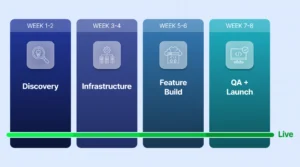
Here’s the part that surprises most healthcare CTOs: the speed wasn’t the result of cutting corners. It was the result of doing fewer things, correctly, in the right order.
We use what we call a Sprint Architecture — a modified Agile framework purpose-built for high-accountability custom software builds where compliance and clinical reliability are non-negotiable.
Before a single line of code was written, the entire two weeks were dedicated to architecture and compliance mapping. What does that look like in practice?
This phase is where most fast projects fail. They skip it. We don’t.
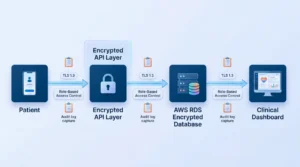
Authentication, role-based access control, audit logging, and the patient data model were built first — before any visible features. This is the unglamorous work that determines whether a healthcare product can actually go to production safely.
ClearPath Health’s CTO sat in on a mid-sprint demo at the end of week four.
His feedback: “I’ve never seen this level of structure from a team this fast.”
With the foundation solid, the product features moved quickly: patient intake forms, appointment scheduling, remote monitoring data display, and integration with their existing EHR system via HL7 FHIR APIs. Real integrations. Not mocked data.
This is the phase where most projects either accelerate or collapse. Because we’d built the architecture correctly, features dropped in without constant rework.
Before any real patient data touched the system, we ran a staged rollout in a production-mirror environment. Penetration testing was completed. All HIPAA-required technical safeguards were independently verified. The clinical staff ran through the full patient journey — not a demo, the actual product.
Day fifty-three: the first real patient onboarded. The system held.
Transparency matters in case studies. Here’s what ClearPath Health’s engagement looked like in concrete terms:
For context — the industry average for a similar-scope healthcare software project typically runs four to six months. The gap isn’t about speed. It’s about process design, accountability, and what decisions get made before the code is written.
If you’re a CTO, VP of Product, or Digital Health Founder evaluating development partners for your next build, the questions that matter most aren’t about price or portfolio. They’re about what happens when things go wrong:
These questions filter out agencies that rent you your own product, hand off to offshore teams you’ve never met, and disappear after go-live.
Healthcare digital transformation isn’t slowing down. The organizations that move in the next twelve months — with the right foundation — will have a significant competitive and operational advantage over those still working through vendor selection in the year after.
The pilot hospital that partnered with ClearPath Health saw patient intake completion rates improve significantly in the first thirty days. Administrative overhead dropped. Clinician time-to-information improved. These aren’t soft benefits — they’re operational metrics that translate directly to clinical capacity.
And they exist because of the decisions made in week one of a fifty-three day build.
We’re not in the business of promising the impossible. Eight weeks worked for ClearPath Health because their product scope was well-defined, their clinical stakeholders were engaged throughout, and they trusted the process.
Not every healthcare MVP needs to be this fast. But every healthcare software project deserves this level of structure — regardless of timeline.
If you’re building something in digital health and you want to understand what’s actually possible, the real costs involved, and what a compliant, reliable architecture looks like for your specific use case — that conversation starts with a thirty-minute discovery call.
No pitch. No templates. Just a direct conversation with the team that will build your product.