Back to Blog Page
The Model Works. The Business Still Can’t Use...
October 13, 2026

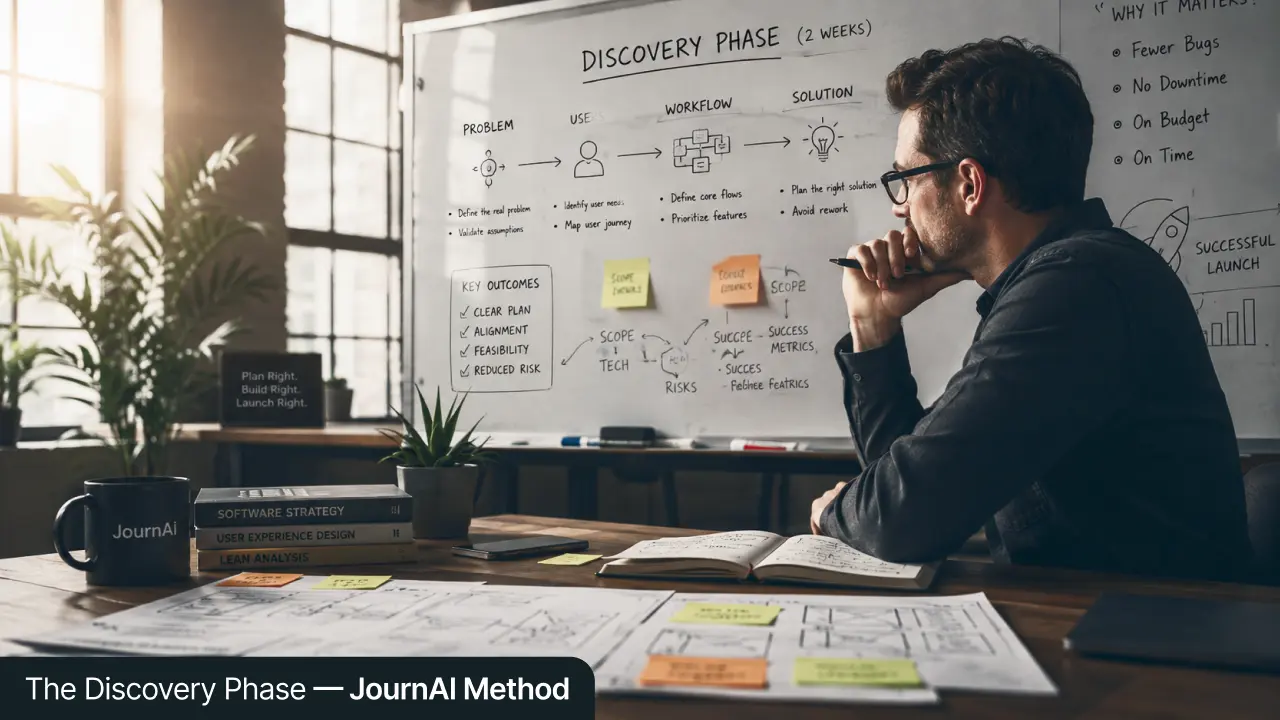
There is a moment every software founder remembers. The one where the developer they hired three months ago — after collecting the deposit and promising a launch date — delivers something that barely resembles what was discussed. Buttons go nowhere. The database can’t handle concurrent users. The payment flow crashes on mobile. And the timeline? Already six weeks past due.
That moment is not a developer failure. It’s a planning failure. And it almost always traces back to the same missing step: a proper discovery phase.
At JournAI, we spend two full weeks in discovery before writing a single line of code. Not because we enjoy meetings. But because the data on what happens when you skip this step is brutal — and we’ve seen it play out with companies that came to us to rescue projects that were already breaking down under their own weight.
The most expensive software bugs are not written in production. They are designed in the first conversation when everyone assumed they were aligned — and weren’t.
Discovery is not a kickoff call. It’s not filling out a requirements document. And it’s certainly not a founder describing their vision while a developer nods along and starts wireframing.
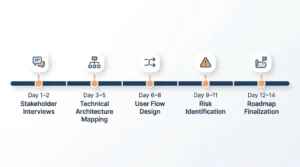
A real discovery phase is a structured, time-boxed investigation that maps every technical, business, and user-facing dimension of what you’re building before architecture decisions are locked in. At JournAI, ours runs across five intentional stages over fourteen days:
→ Stakeholder Interviews — understanding not just what is wanted, but why, and by whom
→ Technical Architecture Mapping — defining the system structure, database schema, and API contracts
→ User Flow Design — walking every persona through every screen decision before they’re built
→ Risk Identification — surfacing integration conflicts, compliance requirements, and scalability constraints
→ Roadmap Finalization — locking the MVP scope with explicit trade-offs documented
Each stage has a deliverable. Each deliverable gets signed off. Nothing moves forward until the previous gate is cleared. This is not bureaucracy — it is how you prevent a $40,000 rebuild eight weeks into a project.
Consider what happened to a logistics SaaS startup that approached a development agency with a clear brief: build a driver dispatch platform with real-time tracking, route optimization, and an admin dashboard. The agency quoted six weeks and started building immediately.
What nobody discussed during that initial call:
→ The app needed to handle offline GPS data syncing when drivers lose signal in rural routes
→ The client already had a legacy fleet management system that needed API integration — one the agency had never worked with
→ Two enterprise clients the startup was about to onboard had conflicting data export format requirements
→ The admin dashboard needed role-based permissions across four user types — not one
Three months later, the product launched with critical bugs in the offline sync feature, broke during the first enterprise onboarding, and required a full refactor of the permissions system. The ‘six-week’ project became a fourteen-month project. The discovery session that could have surfaced all of this? It never happened.
Risky updates, extended downtime, and nobody owning the architecture — these are not random outcomes. They are predictable consequences of building without a proper discovery foundation.

After working across healthcare platforms, fintech applications, and enterprise SaaS products, we’ve identified five failure modes that discovery specifically prevents:
The most stubborn bugs in software are not typos in the code. They’re contradictions in the requirements. When a checkout flow was designed assuming one user session but the backend was built assuming stateless requests, the result is a bug that looks like a code error but is actually an architecture disagreement. Discovery aligns these before they’re built.
A healthcare platform we worked with had initial projections of roughly two hundred active patients. Within four months of launch, they had crossed three thousand. Without a discovery phase that explicitly modeled this growth curve, the database architecture and server configuration would have collapsed under that load. The discovery conversation surfaced it. The architecture was designed accordingly.
When no one mapped which third-party integrations were critical at discovery, teams end up in situations where updating Stripe’s SDK breaks a custom payment flow, or a Twilio update disrupts notification delivery. Discovery creates the dependency map that makes updates safe.
Without a documented discovery output, every new feature request feels equally valid because there’s nothing to compare it against. Teams end up in endless backlog debates. Discovery creates an agreed-upon roadmap that serves as the arbiter — not the loudest voice in the room.
The most dangerous phrase in software development is ‘I assumed someone else was handling that.’ API error handling. Data backup protocols. QA sign-off. When ownership isn’t assigned explicitly during discovery, it falls into the gap between teams. And gaps in software tend to become very expensive, very fast.
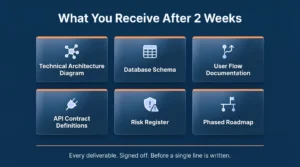
By the end of our two-week discovery phase, every client receives a set of tangible deliverables — not a vague vision document, but specific artifacts that drive the build:
→ Technical Architecture Diagram — a precise map of system components, data flows, and integration points
→ Database Schema — initial entity relationships, constraints, and anticipated growth patterns
→ User Flow Documentation — annotated screen-by-screen journey maps for every persona
→ API Contract Definitions — agreed-upon input/output specifications for every major integration
→ Risk Register — a prioritized list of technical and business risks with mitigation strategies
→ Phased Roadmap — an MVP scope with clearly documented what’s-in and what’s-out decisions
They protect the client from scope drift, and
They protect the development team from building on ambiguous foundations.
The two weeks you invest in discovery are not a delay. They are the only reason the following twelve weeks of development stay on schedule.
A founder building a compliance automation platform for mid-market law firms once pushed back on our discovery process. ‘We know exactly what we need,’ they said. ‘We’ve been thinking about this for eighteen months.’
We ran the discovery anyway. During the architecture mapping session, we identified that their two largest target clients — the ones they’d already promised early access — used different case management systems with incompatible API structures. Neither could be integrated with the approach the founder had been planning.
That conversation happened in week one of discovery. Catching it there cost a planning pivot and two extra days. Catching it after three months of development would have required a complete rebuild of the integration layer.
The founder sent us a message when the product launched on time. ‘That two-week discovery,’ they wrote, ‘was the best money we ever spent.’
Fair question. For very small utility tools or straightforward MVPs with tightly scoped functionality, a condensed version of discovery — sometimes as short as three to five days — may suffice. But for any product that involves:
→ Third-party integrations with enterprise systems
→ Regulated data (healthcare, finance, legal)
→ Multi-tenant or multi-role architectures
→ Projected rapid user growth
→ Revenue-critical workflows
…a full discovery phase is not optional. It is the prerequisite for building something that works at the moment it matters most — launch.
The discovery phase is Phase One of JournAI’s six-phase build process. Once discovery is complete, every subsequent phase — architecture, development, QA, staging, and deployment — has a clear, agreed-upon foundation to build on.
If you’ve experienced a failed software launch, a project that ran months past its deadline, or a product that worked in demos but fell apart under real users — the answer is almost always the same. Someone skipped the planning.
Before committing to any custom software build, ask:
Can every stakeholder with decision-making authority finish this sentence the same way: “The one thing our users must be able to do in session one is ___”? If answers differ, you don’t have a defined product yet. You have a set of assumptions that will conflict in production. Discovery aligns them before the conflict is expensive.
Has every technical dependency, integration requirement, and architectural constraint been validated against your budget and timeline? If not, your budget is a guess. Discovery turns it into a plan.
Is there a signed document defining the MVP scope, the success criteria, the owner of each decision, and the process for handling change requests? If not, you don’t have a scope. You have a starting point for scope creep. Discovery produces the document that prevents it.
At JournAI, the discovery phase is not optional. It’s the investment that makes every dollar after it more effective. Because the most expensive line of code you’ll ever write is the one built on an assumption nobody validated.
Planning a build in Q2? Schedule a discovery engagement. Let’s spend two weeks making sure we’re building the right thing before we spend twelve weeks building it.