Back to Blog Page
The Model Works. The Business Still Can’t Use...
October 13, 2026

At first, the marketplace was easy to manage.
A few vendors were selling several thousand products. Customers could browse the catalog, place orders, and move through checkout without major issues.
Then the marketplace grew.
More vendors joined. Product variants increased. Inventory changed constantly. Customers were searching thousands of products every day.
Then the catalog crossed 100,000 SKUs.
The website was still running, but searches became slower, vendor imports created database pressure, and inventory updates started affecting other operations.
The problem wasn’t simply the number of products.
The architecture had been designed for a small store—not a growing marketplace.
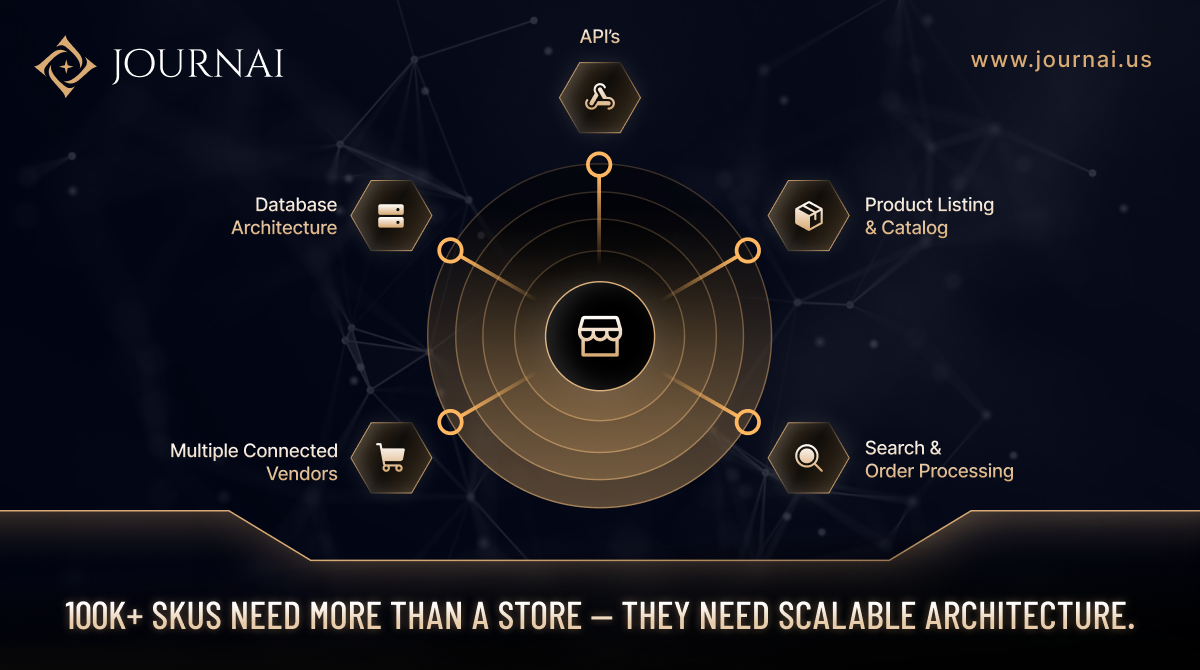
A marketplace at this scale manages much more than product records:
The architecture needs to handle these workloads without forcing everything through the same application and database.
AWS describes e-commerce architectures where product search and order processing can be separated into independently deployable and scalable modules. This allows different workloads to scale according to their individual demands.
The important question isn’t:
“Can we store 100,000 products?”
It is:
“Can we search, update, purchase, and synchronize those products efficiently?”
The product catalog is the foundation of a marketplace.
Instead of keeping everything inside one large product record, separate the major entities:
Product → Variant → Vendor Offer → Price → Inventory → Category → Media
This becomes important when multiple vendors sell the same product.
The product can remain the same while vendors have different prices, inventory levels, and shipping options.
Shopify Engineering recently described a catalog architecture dealing with billions of product listings across millions of stores, highlighting the challenge of representing the same products consistently across different merchants.
The lesson is simple:
Product data needs structure before it needs scale.
Imagine a customer searching:
“Black running shoes, size 10, under $100.”
The system may need to search product names, categories, sizes, colors, prices, vendors, and availability.
Doing all of this directly against the main transactional database can create unnecessary load.
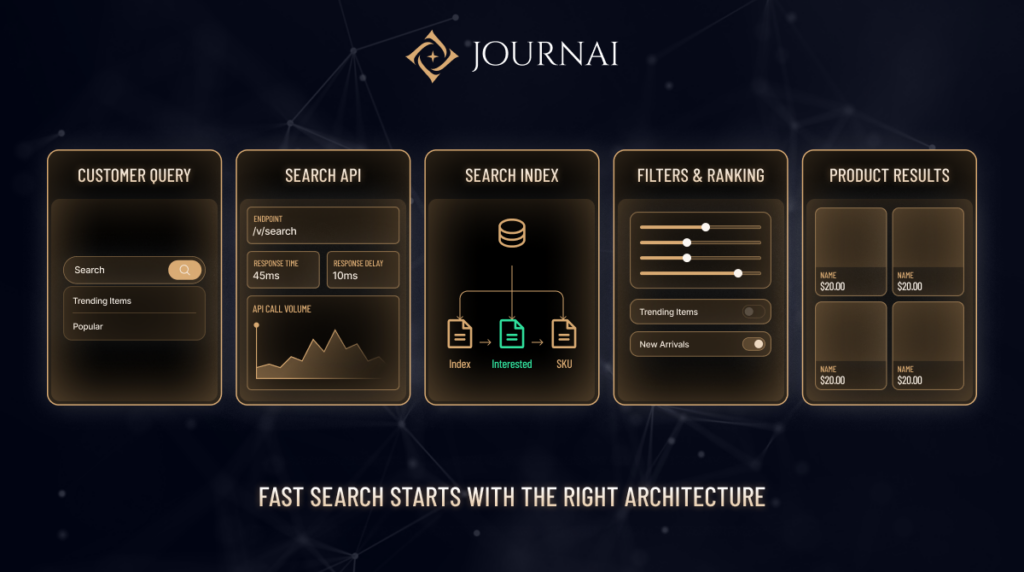
A better approach is:
Product Database → Search Index → Search API → Customer
Modern e-commerce search systems commonly support capabilities such as search, autocomplete, facets, category pages, and product recommendations.
This allows the primary database to focus on transactions while the search layer handles product discovery.
Search can tolerate some indexing delay.
Inventory often cannot.
If a vendor has one laptop remaining and two customers purchase it at the same time, the platform must prevent both orders from claiming the same stock.
The architecture should therefore handle:
Inventory is not simply product information. It is transactional business data.
A growing marketplace may include:
A strong API layer allows these applications to share the same business logic.
Heavy operations such as vendor imports, search indexing, image processing, notifications, and analytics can run through queues and background jobs instead of slowing down customer-facing requests.
This is where Laravel Web Development Services can provide a flexible foundation for APIs, authentication, integrations, and marketplace workflows.
Not necessarily.
A marketplace reaching 100k SKUs does not automatically need dozens of microservices.
A well-structured modular monolith can be a practical starting point.
The important thing is to create clear boundaries around:
Catalog | Search | Vendors | Inventory | Orders | Payments
As traffic grows, individual workloads can be scaled or separated where necessary.
The goal isn’t more services. The goal is the right architecture.
Laravel can provide a strong foundation for custom marketplace applications supporting:
For businesses with unique marketplace requirements, Custom Web Development Services can create an architecture around their actual workflows.
A Custom Laravel Development Company should also consider database design, search, caching, queues, monitoring, security, and infrastructure—not only application code.
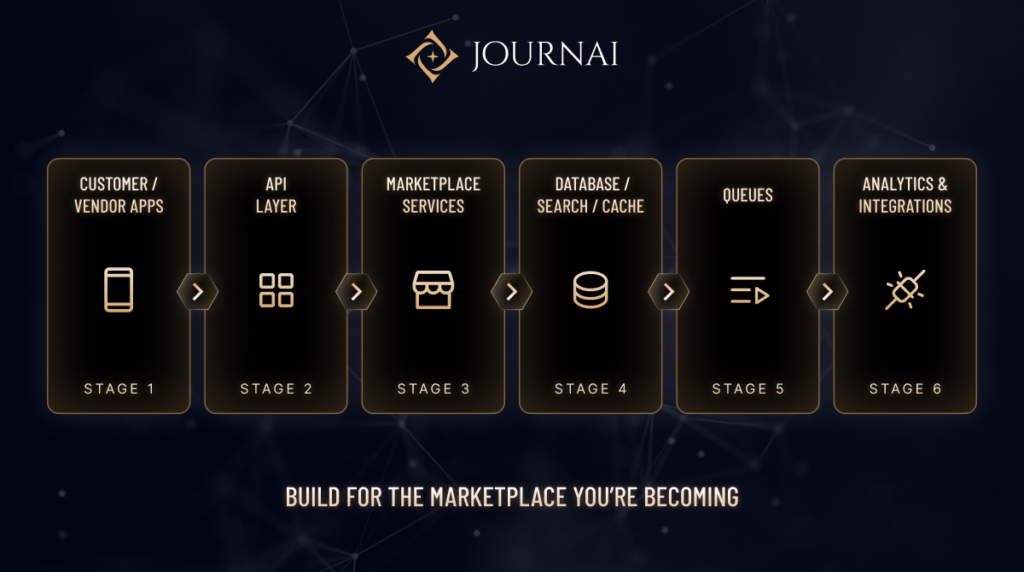
A practical architecture can look like:
Customer / Vendor Apps
↓
CDN + Load Balancer
↓
API Layer
↓
Catalog | Search | Vendor | Inventory | Orders | Payments
↓
Database | Search Index | Cache
↓
Queues / Events
↓
Analytics | Notifications | Integrations
The architecture can start simple and evolve as individual workloads grow.
For a 100k+ SKU marketplace:
Yes. SKU count alone does not determine scalability. Database design, search, caching, infrastructure, and traffic patterns also matter.
No. A modular monolith can be a practical starting point. Services can be separated when independent scaling becomes necessary.
For large catalogs, a dedicated search layer can reduce database pressure and improve filtering, autocomplete, and product discovery.
The marketplace in our opening story didn’t struggle because it had 100,000 products.
It struggled because its architecture hadn’t evolved with the business.
A successful marketplace becomes an interconnected system of products, vendors, inventory, search, orders, payments, and integrations.
The right architecture doesn’t simply help a business handle 100,000 SKUs.
It gives the business room to add the next 100,000.
Our Laravel Development Services help businesses build scalable marketplace platforms with structured catalogs, vendor management, APIs, search, inventory, integrations, and performance-focused architecture.
Whether you need to Hire Laravel Developers for an existing platform or need Custom Laravel Development for a new marketplace, we can help build around your business requirements.
Build faster. Scale smarter. Create a marketplace ready for what’s next.