Back to Blog Page
The Model Works. The Business Still Can’t Use...
October 13, 2026


The quarterly finance review was supposed to be straightforward.
Revenue targets were healthy.
Customer growth was moving in the right direction.
Hiring plans were already approved.
Then a single spreadsheet changed the entire discussion.
The organization had accumulated more than twenty software subscriptions across departments.
Sales teams relied on one reporting platform.
Operations teams depended on one another.
Customer support maintained its own analytics tool.
Finance exported spreadsheets because none of the systems communicated effectively with each other.
Several departments were paying for different solutions that solved almost identical problems.
The monthly software bill had quietly become one of the largest operational expenses in the company.
Even more concerning, employees were still spending hours every week moving information manually between systems.
Technology had been introduced to simplify operations.
Instead, technology had become another layer of operational complexity.
This story is becoming increasingly common across startups, mid-sized businesses, and enterprises.
And it explains why custom AI dashboards are rapidly replacing expensive SaaS seats.
Organizations are no longer searching for more software.
Organizations are searching for better visibility, faster decisions, and fewer systems standing between teams and the information they need.
For more than a decade, digital transformation followed a familiar pattern.
A new challenge appeared.
A new subscription solved it.
Need customer management?
Purchase a CRM.
Need project visibility?
Add project management software.
Need employee management?
Implement an HR platform.
Need analytics?
Purchase another dashboard.
Need customer support?
Introduce a ticketing system.
Every decision made sense individually.
Collectively, those decisions created software sprawl.
Modern organizations often operate with:
The result is not simplicity.
The result is fragmentation.
Information becomes scattered.
Processes become disconnected.
Visibility disappears.
Subscription pricing is only the visible cost.
The higher costs remain hidden beneath the monthly invoice.
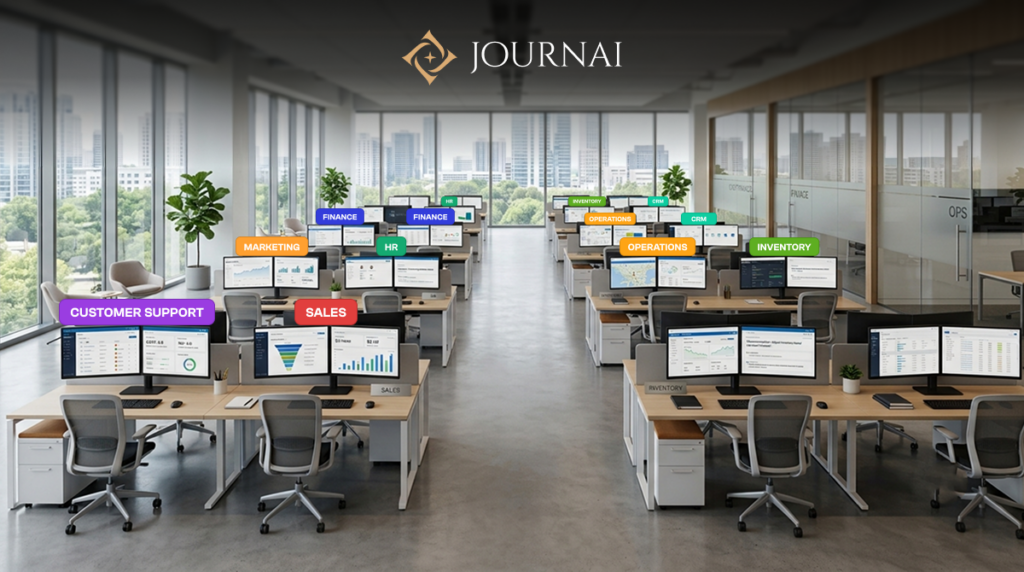
Employees spend significant portions of their day switching between applications.
Customer information exists in one system.
Financial information lives somewhere else.
Operational metrics appear in another dashboard entirely.
Finding answers becomes a process rather than an action.
A few minutes lost every hour eventually become hundreds of lost hours every month.
Teams begin recreating reports manually.
Departments maintain separate spreadsheets because centralized reporting no longer exists.
The same information gets entered multiple times into multiple systems.
Businesses unknowingly pay talented employees to move information rather than act on it.
Perhaps the largest cost is trust.
When different systems provide different answers to the same business question, confidence in data begins to disappear.
Executives stop trusting dashboards.
Managers request manual validation.
Decision-making slows down.
Growth slows down with it.
The financial impact becomes even larger as organizations scale.
A platform costing forty dollars per user every month may appear affordable with twenty employees.
At three hundred employees, that same platform becomes a substantial annual expense.
Multiply that cost across fifteen or twenty different systems, and software expenditure begins growing faster than operational value.
Many organizations respond to software complexity by purchasing additional software.
Unfortunately, that approach often creates even more complexity.
Traditional SaaS models reward vendors when organizations hire more employees.
The more successful the business becomes, the larger the software bill becomes.
Growth and software expenditure become directly linked.
Technology costs rise even when operational efficiency does not.
Software companies design products for thousands of organizations.
Every business operates differently.
As a result, teams frequently redesign internal processes to fit software limitations rather than allowing technology to support the way the business already operates.
Operational friction becomes unavoidable.
Modern organizations rarely operate using a single platform.
CRM systems need finance data.
Finance systems need operational data.
Operations need customer information.
Customer support needs visibility into everything.
Every integration creates another dependency.
Every dependency creates another maintenance challenge.
Businesses eventually purchase software simply to connect existing software.
As organizations become dependent on platforms, replacing them becomes expensive and risky.
Migration projects become multi-month initiatives.
Innovation slows down.
Business agility disappears.
The market response is already visible.
Instead of purchasing more tools, organizations are investing in intelligence layers that sit above existing systems.
According to Gartner, decision intelligence is becoming a major enterprise investment area because organizations want analytics, automation, and business context combined into a single operational layer.
McKinsey research also shows that organizations successfully scaling AI are achieving measurable gains in productivity and operational performance.
Microsoft continues reporting rapid enterprise adoption of AI copilots and AI-powered workflows designed to eliminate repetitive work and improve decision speed.
The direction of the market is becoming clear.
Organizations do not want more dashboards.
Organizations want fewer dashboards that provide better answers.
This shift is creating the demand for custom AI dashboards.
The answer is not another software subscription.
The answer is a centralized intelligence layer.
A custom AI dashboard acts as a business operating system that brings together information from every major platform and transforms it into actionable insights.
Instead of opening six applications every morning, teams open one intelligent workspace.
That workspace can:
Most importantly, the dashboard reflects how the organization actually operates.
Not how a software vendor assumes organizations should operate.
That difference changes everything.
Custom AI dashboards are business-first rather than feature-first.
The objective is not to provide more functionality.
The objective is to remove unnecessary complexity and surface only the information that matters.
Employees stop searching for information.
Information finds employees.
Executives stop waiting for reports.
Reports become available instantly.
Operations stop reacting to problems.
Operations begin predicting them.
Healthcare organizations often operate across appointment systems, billing software, staffing tools, compliance reporting platforms, and patient management systems.
A custom AI dashboard can unify these environments and provide:
Healthcare leaders gain a complete operational picture without switching between systems.
Manufacturers typically manage inventory, procurement, production planning, supplier management, and maintenance across multiple platforms.
AI dashboards can identify:
Operations teams move from reactive management to proactive decision-making.
Logistics organizations often rely on separate systems for fleet tracking, warehouse operations, route planning, and customer communication.
Custom AI dashboards can provide:
Small improvements in visibility create significant financial savings at scale.
Retail organizations generate enormous amounts of customer and inventory data every day.
AI dashboards can provide:
Decision-making becomes faster and significantly more accurate.
The future of enterprise software development is unlikely to involve more applications.
The future is likely to involve fewer interfaces powered by more intelligence.
Organizations are already moving toward:
Soon, executives may simply ask:
“Which customers are most likely to churn next quarter?”
“Which projects are most likely to miss delivery timelines?”
“Which regions require immediate operational attention?”
“Which products require inventory replenishment?”
The answer will appear instantly.
No spreadsheets.
No report building.
No waiting.
Software is evolving from record keeping to decision intelligence.
Organizations that embrace this shift early are likely to gain significant competitive advantages over those still managing disconnected systems.

Custom AI dashboards are replacing expensive SaaS seats because organizations are no longer willing to accept fragmented workflows, disconnected systems, and rising subscription costs.
Organizations want visibility.
Organizations want automation.
Organizations want intelligence.
Most importantly, organizations want technology that adapts to the business rather than forcing the business to adapt to technology.
As AI capabilities continue to mature and software costs continue to rise, custom AI dashboards are rapidly becoming the operating layer of modern enterprises.
The question is no longer whether organizations will move in this direction.
The question is how quickly they can get there.
At JournAI, we help organizations move beyond disconnected software ecosystems by building custom AI dashboards that unify systems, automate workflows, and provide real-time business intelligence.
If rising SaaS costs and fragmented operations are slowing growth, now may be the right time to explore what a centralized AI platform could look like.
Talk to our team about building an AI-driven digital solution designed around the way the organization actually operates.